Chapter Overview
Between 1800 and 1850, the American economy underwent a transformation so dramatic that historians call it the Market Revolution. New roads, canals, and railroads shrank distances. Factories began turning out goods that skilled artisans had once made by hand, one at a time, in small workshops. Farmers who had grown food mainly for their own families began raising crops to sell in distant markets as well. Money, not barter, became the way people exchanged goods. This revolution created enormous wealth—but also enormous inequality. It drew women into factories, accelerated the demand for enslaved labor in the South, and divided the country into two very different economic systems that would eventually collide.
Big Questions
- How did new transportation technologies reshape the American economy and landscape?
- What was it like to work in an early American factory?
- How did the Market Revolution change daily life for ordinary Americans?
- Who benefited from the Market Revolution—and who paid the price?
I. Introduction: The World Speeds Up
In 1800, it took about six weeks to travel from New York to the spot on Lake Michigan where Chicago stands today—there was no Chicago yet. By 1857, the same trip took two days by train. That single fact—the compression of distance and time—captures the essence of the Market Revolution.
Before the Market Revolution, most Americans were farmers who grew food for their own families. They made their own clothes, built their own furniture, and traded with neighbors. For most people, everyday life stayed close to home—the farm, the neighbors, the nearest town—though plenty of families did pull up stakes and move hundreds of miles west. Money was scarce. Life moved slowly.
By the 1850s, everything had changed. Railroads crisscrossed the nation. Factories churned out goods. Farmers grew cash crops for distant markets. People bought clothes and tools from stores instead of making them by hand. Americans were connected to a national—and international—economy in ways that would have been unimaginable a generation earlier.
This transformation created the modern American economy. It also created the modern American class system—a widening gap between rich and poor, owners and workers, that would define the nation's politics and culture for centuries to come.
Vocabulary
Market Revolution: The dramatic transformation of the American economy between about 1800 and 1850, driven by new transportation, new factories, and the shift from subsistence farming to commercial agriculture.
Subsistence farming: Growing food for your own family's use rather than for sale. Before the Market Revolution, most American farmers practiced subsistence farming.
Commercial agriculture: Growing crops specifically to sell in a market for profit—the opposite of subsistence farming.
II. The Transportation Revolution
Roads and Turnpikes
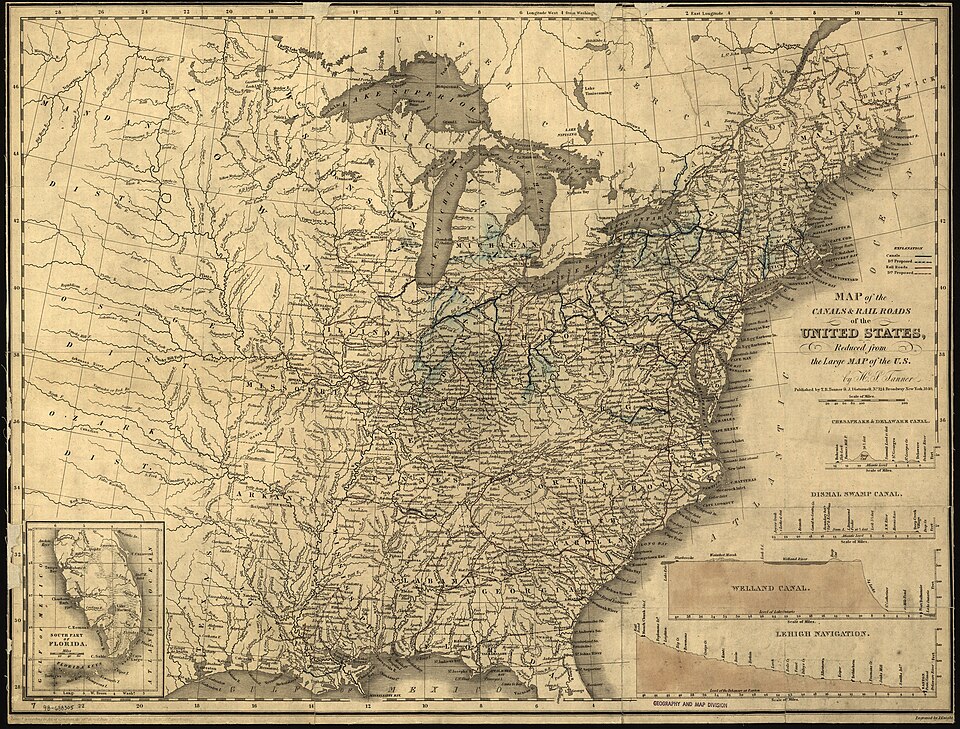
In the early 1800s, American roads were terrible. Most were little more than rutted dirt paths that turned to mud in the rain. Transporting goods overland was slow, expensive, and unreliable. The federal government built the National Road (also called the Cumberland Road), which began inching west from Cumberland, Maryland, in 1811 and did not reach Illinois until 1839. States chartered private companies to build toll roads called turnpikes. But roads alone couldn't solve the problem.
The Canal Craze
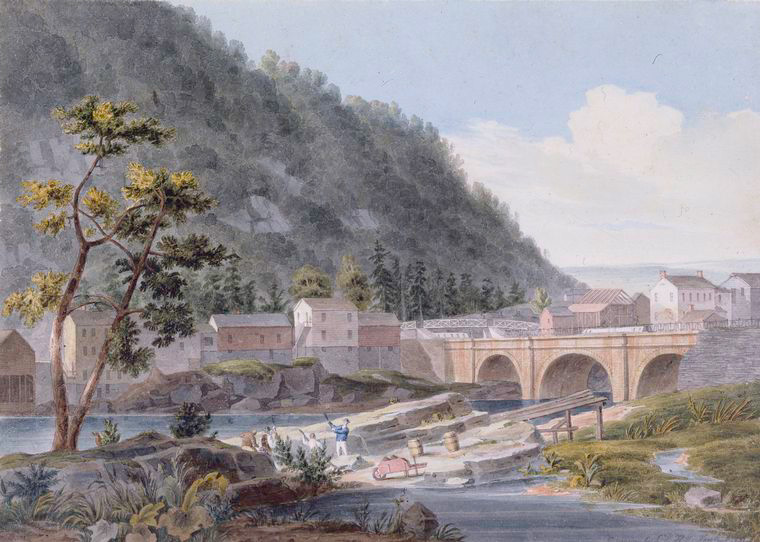
Water was the answer. In 1825, New York completed the Erie Canal—a 363-mile waterway connecting the Great Lakes to the Hudson River and, from there, to New York City. The canal was an engineering marvel and an economic blockbuster. It slashed the cost of shipping goods from the interior by 90%. Farmers in Ohio and Indiana could now ship grain to New York City cheaply. New York City became the nation's commercial capital. Towns along the canal—like Buffalo, Rochester, and Syracuse—boomed.
The Erie Canal's success sparked a national frenzy of canal building. States across the country dug canals connecting rivers, lakes, and cities. Not all of them were profitable—many went bankrupt—but together they knit the nation's economy together as never before.

Story Behind the Story: "Clinton's Ditch"
People had been arguing about a canal across New York since the 1780s, but nobody pushed harder for it than DeWitt Clinton—so hard that critics named the project after him, mocking it as "Clinton's Ditch." Building a 363-mile canal through wilderness, swamps, and solid rock seemed insane. The project took eight years and cost $7 million (roughly $200 million today). Workers—many of them Irish immigrants—dug with shovels and pickaxes, battled malaria in the swamps, and blasted through rock with black powder. Stories spread that a thousand men had died of "swamp fever" in the marshes, but nobody kept count, and historians have never found records or graves to match. How many died is still unknown. When the canal opened in 1825, Clinton rode a packet boat called the Seneca Chief the whole length of it from Buffalo to Albany, then down the Hudson to New York City. At the end of the ten-day voyage he emptied casks of Lake Erie water into New York Harbor, symbolizing the "wedding of the waters." Tolls poured in from the first year, and by 1837 the state had paid off every dollar it had borrowed to build the canal. Within a decade, the canal had transformed the American economy.
Railroads: The Game Changer
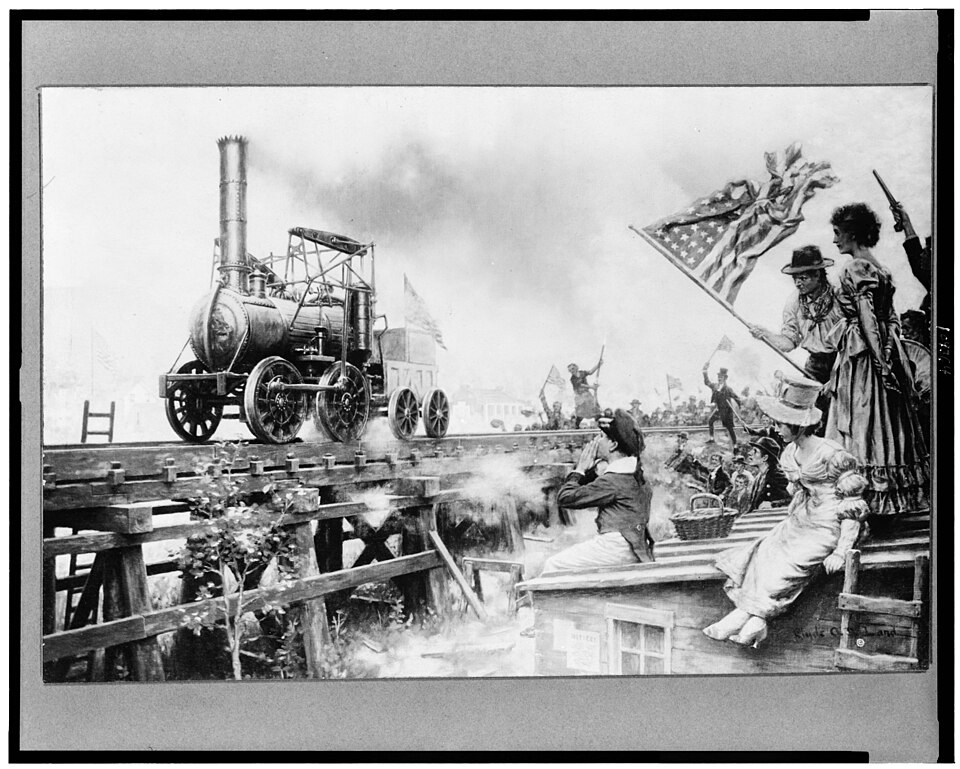
Canals were impressive, but railroads were revolutionary. By the 1830s, steam-powered trains were spreading across the eastern United States. By 1860, the country had over 30,000 miles of railroad track—more than any other nation on earth, and nearly three times as much as Great Britain.
Railroads were faster than canals, could operate year-round (canals froze in winter), and could go places canals couldn't. They connected farms to cities, raw materials to factories, and producers to consumers. They also forced Americans to agree on what time it was: before railroads, every town set its own clocks by the sun, and the railroads eventually replaced that patchwork with standard time zones—though not until 1883, well after the years in this chapter. They even changed how Americans thought about distance: places that had seemed impossibly far were now just a train ride away.
Stop and Think
How might your daily life be different if a message or package from a faraway city took six weeks to reach you instead of one or two days? What would you not be able to do?
III. The Factory System
From Workshops to Factories
Before the Market Revolution, most goods were made by hand—and most of them were made at home. Farm families spun thread, wove cloth, sewed their own clothes, and built their own furniture. What they could not make themselves they got from a local artisan: a shoemaker made shoes one pair at a time, a blacksmith forged tools individually. Either way, each item was one of a kind, made by a skilled person who controlled every step of the process.
Factories changed all of that. Using machines powered by water and steam, factories could produce goods faster, cheaper, and in greater quantities than any artisan. But factory work was fundamentally different from craft work. Instead of making a whole product, each worker performed one small, repetitive task—over and over, for 12 to 14 hours a day.
The Lowell Mills: A New Experiment
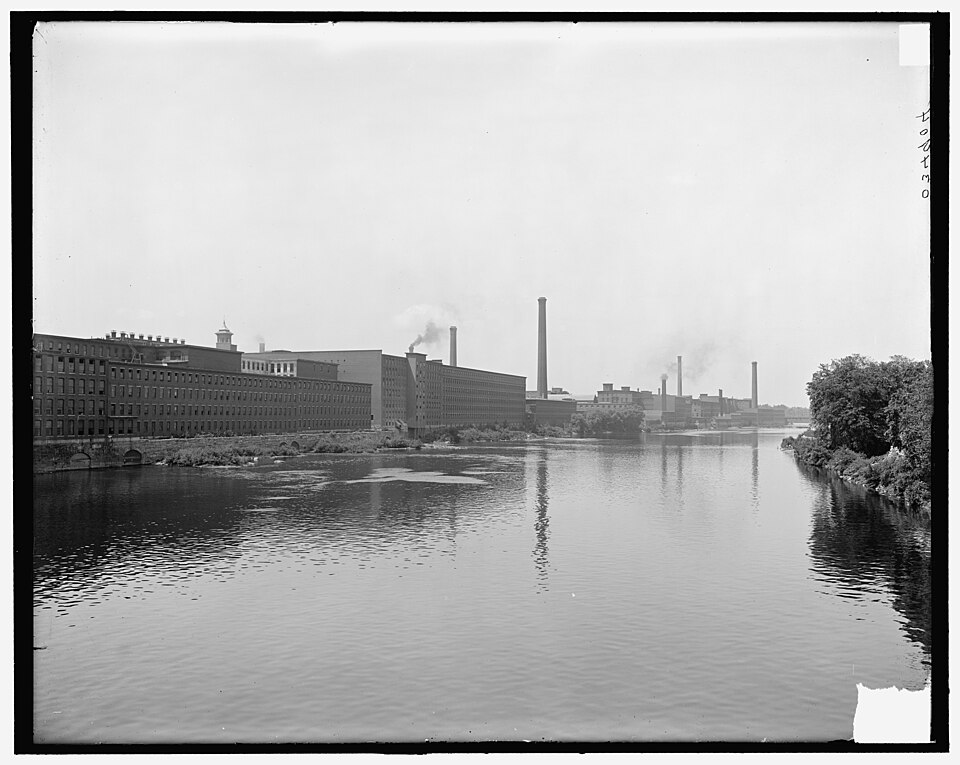
One of the most famous early factories was the textile mill complex at Lowell, Massachusetts. Beginning in the 1820s, factory owners recruited young, unmarried women from New England farms to work in the mills. These "Lowell mill girls" left home for the first time, earned their own wages, and lived in supervised boarding houses.
At first, the system seemed progressive. The women earned money, gained independence, and had access to libraries and lectures. But the promise wore thin. Over the next two decades, as competition among the mills grew fiercer, owners cut wages, sped up the machines, and gave each woman more looms to tend at once. The work was deafening, the air filled with cotton dust that destroyed workers' lungs, and the hours were brutal—typically 12 to 14 hours a day, six days a week.
Primary Source: A Lowell Mill Girl Describes Factory Life
"I worked first in the spinning-room as a 'doffer.' The doffers were the very youngest girls, whose work was to doff, or take off, the full bobbins, and replace them with the empty ones. I can see myself now, racing down the alley, between the spinning-frames, carrying in front of me a bobbin-box bigger than I was. These mites had to be very swift in their movements, so as not to keep the spinning-frames stopped long, and they worked only about fifteen minutes in every hour. The rest of the time was their own… The working-hours of all the girls extended from five o'clock in the morning until seven in the evening, with one-half hour for breakfast and for dinner. Even the doffers were forced to be on duty nearly fourteen hours a day, and this was the greatest hardship in the lives of these children."
—Harriet Hanson Robinson, Loom and Spindle; or, Life Among the Early Mill Girls (1898). Robinson went into the mills at about age ten, around 1835, and wrote this down more than sixty years later. Notice what she does and does not complain about—and that she is describing the mills' earliest years, before the wage cuts and the speed-ups. She remembered them more warmly than the women who came after her did.
Workers Fight Back
As conditions worsened, workers organized. The Lowell mill girls staged "turn-outs" (strikes) in 1834 and 1836. The first protested a wage cut. The second protested a rent increase in the company boarding houses—which came to the same thing, since board was taken straight out of a worker's pay. Nearly a decade later, in 1845, Lowell's mill women founded the Lowell Female Labor Reform Association and sent the Massachusetts legislature petitions signed by thousands of workers demanding a ten-hour workday. Male workers organized too: shoemakers, carpenters, and other trades formed early labor unions to bargain for better wages and working conditions.
But factory owners had the upper hand. They could replace striking workers—often with desperate immigrants willing to work for less. Early labor organizing won some victories, but the fundamental power imbalance between owners and workers remained.
Vocabulary
Factory system: A method of manufacturing in which workers and machines are concentrated in a single building, producing goods in large quantities through division of labor.
Strike (turn-out): An organized work stoppage by employees to protest wages or working conditions.
Labor union: An organization of workers formed to bargain collectively with employers for better wages, hours, and working conditions.
IV. Workers and Work
Immigration and the Labor Force
The Market Revolution coincided with a massive wave of immigration. Between 1820 and 1860, about 5 million immigrants arrived in the United States—mostly from Ireland and Germany. Irish immigrants, many fleeing the devastating Potato Famine (1845–1852), arrived desperately poor and willing to take any work available. They built canals, laid railroad tracks, and filled the lowest-paid factory jobs. They faced vicious discrimination—newspaper advertisements for jobs often ended with the words "No Irish need apply," most commonly in the 1840s, and the phrase appeared on signs in shop windows as well.
German immigrants were often more skilled and better funded. Many settled in the Midwest, becoming farmers, brewers, and skilled craftsmen. But they too faced hostility from native-born Americans who feared that immigrants were stealing jobs, changing the culture, and (because many Irish and German immigrants were Catholic) threatening Protestant values.
Child Labor
Children as young as seven or eight worked in factories, mines, and workshops. They were small enough to crawl under machines to fix jams, and their tiny fingers could handle delicate tasks. They were also cheap—children earned a fraction of what adults made. For many poor families, children's wages were essential for survival. But the cost was devastating: lost childhoods, mangled bodies, and stunted educations.
Multiple Perspectives: Was the Market Revolution Progress?
Stop and Think
The Market Revolution made goods cheaper and more available, but it also created dangerous working conditions and growing inequality. Do the benefits of economic "progress" justify the costs? Who gets to decide?
V. A Market Society
The Cult of Domesticity
The Market Revolution didn't just change work—it changed families. As men increasingly left home to work in factories and offices, a new ideal took hold for middle-class white women. They were expected to stay home, raise children, manage the household, and serve as the family's moral and spiritual center. The home was supposed to be a peaceful refuge from the competitive, cutthroat world of the market. Americans at the time called this a woman's "sphere." The name we use for it today—the cult of domesticity—is a label historians invented much later, looking back.
This ideal applied mainly to middle-class and wealthy white women. Poor women, immigrant women, and enslaved women had always worked—and continued to. The cult of domesticity was as much about class as it was about gender.
The Growth of Cities
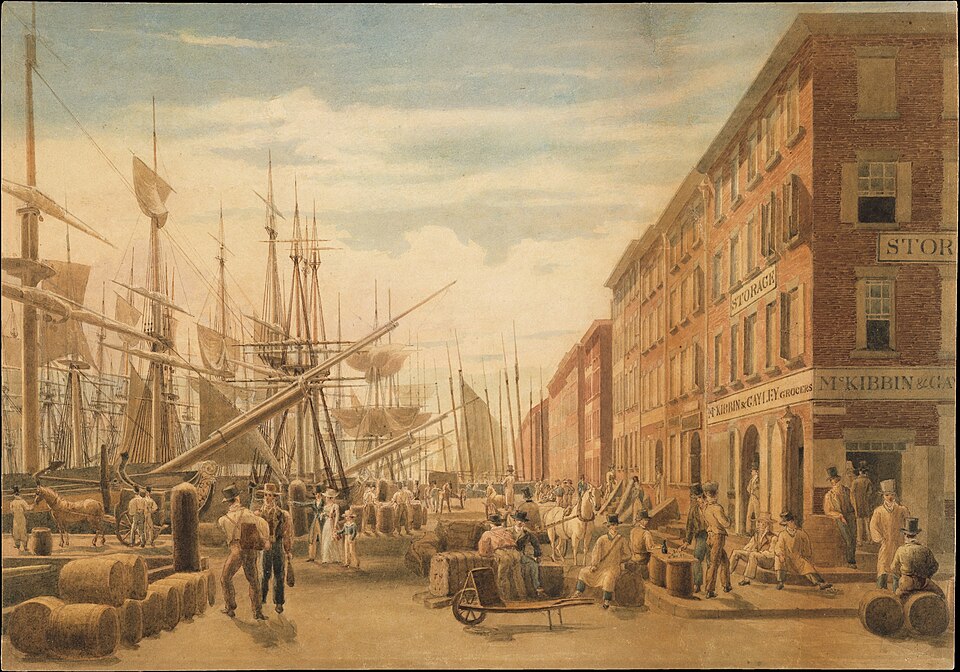
The Market Revolution fueled explosive urban growth. New York City's population grew from 60,000 in 1800 to over 800,000 by 1860. Cities became centers of commerce, manufacturing, and immigration—but also of poverty, disease, and overcrowding. Wealthy families lived in elegant townhouses while workers crammed into filthy tenements. Cholera swept American cities in 1832 and again in 1849, hitting the poorest neighborhoods hardest, and typhoid and other diseases were never far away in districts where clean water and sewers arrived late or not at all.
Key Idea: Two Economies, One Country
The Market Revolution deepened the divide between North and South. The North industrialized—building factories, railroads, and cities. The South doubled down on agriculture, expanding cotton production powered by enslaved labor. The two economies were tied together—Northern mills spun Southern cotton, and Northern banks and ships financed and carried the trade—but most of the crop was shipped overseas, above all to the textile mills of Britain. The two regions still built very different societies, with very different values and interests. This growing divide—between free labor and slave labor, between industry and agriculture—would eventually tear the nation apart.
VI. Wrapping Up: Progress for Whom?
The Market Revolution set the United States on the road from a nation of small farmers to a commercial and industrial power, though the journey was far from over. In 1860, more than half of all working Americans still made their living from the land—but they now grew for distant markets as well as for their own tables. The revolution connected the country through roads, canals, and railroads. It made goods cheaper and more available. It created new opportunities for wealth and mobility.
But it also created a new kind of inequality. Factory workers toiled in dangerous conditions for low wages while owners accumulated fortunes. Women were pushed into a narrow domestic role—or forced into factory labor with no protections. Immigrants faced exploitation and discrimination. And in the South, the Market Revolution's appetite for cotton intensified the demand for enslaved labor, making slavery more profitable and more entrenched than ever.
The Market Revolution's central question—who benefits from economic growth and who bears its costs—remains one of the most important questions in American life.
Whose Voices Were Left Out?
Factory children: Thousands of children worked in factories and mines from the age of seven or eight. They left few records. Their lost childhoods, injuries, and stunted opportunities are among the hidden costs of industrialization.
Irish immigrant women: Irish women who worked as domestic servants in middle-class and wealthy households left few records of their own, and those few were ignored for a long time. They were essential to the comfortable life they served but were treated as invisible. Historians have since collected letters that Irish immigrants sent home, and some of them were written by women who worked as servants.
Enslaved people who produced the cotton: The Market Revolution's most important commodity—cotton—was grown overwhelmingly by enslaved people. Their labor powered the Southern economy and the textile mills of the North, and even more of the crop they raised crossed the Atlantic to the mills of Britain. But their voices are rarely centered in stories about economic "progress."
Chapter Activity: Winners and Losers
The Task:
Create a two-column chart: "Winners" and "Losers" of the Market Revolution. For each group below, decide whether they primarily benefited or suffered—and explain your reasoning with evidence from the chapter.
- Factory owners
- Lowell mill girls
- Small farmers
- Irish immigrants
- Enslaved people in the South
- Middle-class white women
- Consumers (people who buy goods)
- Skilled artisans (shoemakers, blacksmiths)
Discussion Questions:
- Can someone be both a "winner" and a "loser"? Give an example.
- Is economic growth always good? When might it cause more harm than good?
- What connections do you see between the Market Revolution and our economy today?