Historical Thinking Skills
As you read each source, practice these four skills:
- Sourcing Who created this? When? Why?
- Contextualization What was happening when this was created?
- Close Reading What exactly does it say? What stands out?
- Corroboration How does it compare to other sources?
Virginia Slave Code Excerpts (1705)
Before You Read
Virginia's slave codes turned slavery from a practice into a legal system. These laws defined enslaved people as property, not persons. Notice how specific and deliberate the language is — this wasn't accidental. It was engineered.
All servants imported and brought into the Country… who were not Christians in their native Country… shall be accounted and be slaves. All Negro, mulatto and Indian slaves within this dominion… shall be held to be real estate… If any slave resists his master… and the slave happens to be killed in such correction… the master shall be free of all punishment… as if such accident never happened.
Vocabulary
- dominion — territory under control of a ruler
- real estate — property (as applied to people, this meant enslaved people could be bought, sold, and inherited like land)
- correction — punishment (a euphemism used to make violence sound acceptable)
- mulatto — a person of mixed racial ancestry (a term considered offensive today)
Sourcing Questions
- Who wrote this law? Who did it benefit?
- Why would lawmakers want to put slavery into legal language?
Close Reading
- The law says enslaved people are "real estate." What does that mean, and why does that language matter?
- What does the final sentence tell you about the value placed on enslaved people's lives?
Corroboration
How do these laws help explain why slavery became so deeply entrenched in colonial America?
Citation
"An Act Concerning Servants and Slaves." The Statutes at Large; Being a Collection of All the Laws of Virginia. Vol. 3. Edited by William Waller Hening. 1705.
Benjamin Franklin, "Join, or Die" (1754)
Before You Read
This is considered the first political cartoon published in an American newspaper. Benjamin Franklin created it to urge the colonies to unite during the French and Indian War. The snake is cut into pieces, each labeled with a colony's initials.
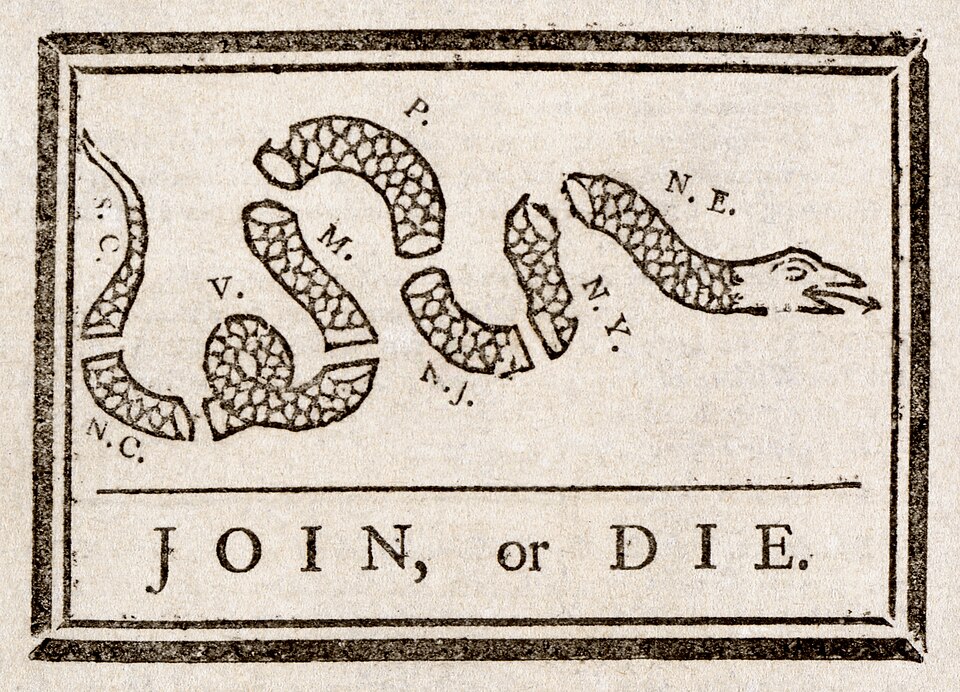
Benjamin Franklin, "Join, or Die," The Pennsylvania Gazette, May 9, 1754. Source: Library of Congress (public domain).
Guided Observation
- Why a snake? (There was a popular belief that a cut snake could survive if its pieces were joined back together.)
- Which colonies are represented? Are any missing?
- How does this cartoon make its argument without using many words?
Corroboration
The textbook says the colonies were separate and often in conflict. How does this cartoon support that idea?
Citation
Franklin, Benjamin. "Join, or Die." The Pennsylvania Gazette, 9 May 1754. Library of Congress.
Phillis Wheatley, "On Being Brought from Africa to America" (1773)
Before You Read
Phillis Wheatley was kidnapped from West Africa at age 7 and enslaved in Boston. She became the first African American woman to publish a book of poetry. This short poem is often debated — is she grateful for being enslaved? Or is she making a much more subversive argument? Read the last two lines very carefully.
'Twas mercy brought me from my Pagan land, / Taught my benighted soul to understand / That there's a God, that there's a Saviour too: / Once I redemption neither sought nor knew. / Some view our sable race with scornful eye, / "Their colour is a diabolic die." / Remember, Christians, Negroes, black as Cain, / May be refin'd, and join th' angelic train.
Vocabulary
- benighted — in a state of darkness or ignorance
- sable — black or dark-colored
- diabolic — devilish
- redemption — being saved or rescued
- refined — purified
- angelic train — the company of angels
Sourcing Questions
- Wheatley was enslaved when she wrote this. How might that affect what she could say openly?
- Her poems had to be approved by a panel of white men before publication. What does that tell you?
Close Reading
- In the first four lines, Wheatley seems to accept slavery. But what is she really saying in the last two lines?
- Who is her audience? What is she asking them to do?
- Why might an enslaved poet need to write this way — seeming to agree while actually challenging?
Corroboration
How does Wheatley's poem connect to the broader story of African Americans in colonial society?
Citation
Wheatley, Phillis. "On Being Brought from Africa to America." Poems on Various Subjects, Religious and Moral. 1773.
Anne Bradstreet, "To My Dear and Loving Husband" (1678)
Before You Read
Anne Bradstreet was the first published poet in British North America — and she was a woman in Puritan Massachusetts, where women were expected to be silent and obedient. Her poetry about love, family, and faith gives us a rare window into colonial women's inner lives.
If ever two were one, then surely we. / If ever man were lov'd by wife, then thee; / If ever wife was happy in a man, / Compare with me, ye women, if you can. / I prize thy love more than whole Mines of gold / Or all the riches that the East doth hold.
Vocabulary
- prize — to value highly
- doth — does (archaic)
- Mines of gold — wealth
- the East — the wealthy trading regions of Asia
Sourcing Questions
- What does it mean that the first published poet in British America was a woman? What obstacles might she have faced?
Close Reading
- What does Bradstreet value more than wealth?
- What does this poem reveal about women's emotional lives in Puritan New England?
Corroboration
How does this poem challenge the image of Puritans as stern and joyless?
Citation
Bradstreet, Anne. "To My Dear and Loving Husband." Several Poems Compiled with Great Variety of Wit and Learning. 1678.
Broadside Advertising a Cargo of Enslaved People, Charleston (1769)
Before You Read
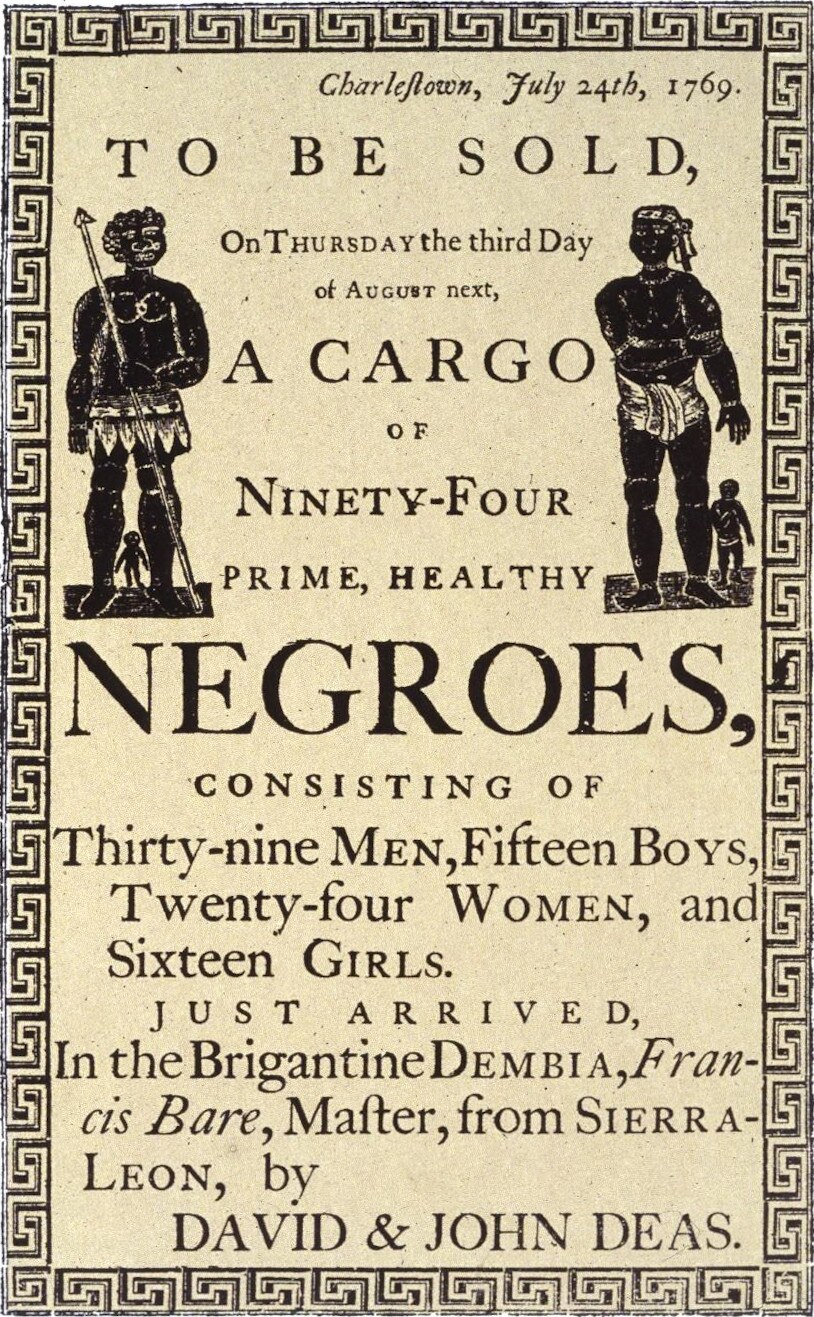
This is an advertisement. It was printed and posted around Charleston to tell buyers that a ship had arrived and that the people aboard it would be sold on a particular Thursday in August. Ninety-four human beings had just survived a voyage from Sierra Leone, in West Africa, in a ship called the Dembia. The advertisement counts them the way a merchant counts goods: thirty-nine men, fifteen boys, twenty-four women, sixteen girls.
Read the language carefully, because the language is the point. The word at the top is “cargo.” The word used for people is “prime, healthy.” David and John Deas, the merchants whose names appear at the bottom, were ordinary Charleston businessmen doing what the law and the economy of their colony permitted. Nothing about this document was secret or shameful to the people who printed it.
These were ninety-four specific people, with names, families, and homes, none of which this piece of paper records.
Vocabulary
- broadside — a single printed sheet posted in public, like a poster
- cargo — goods carried by a ship; using it for people is the whole horror of this document
- brigantine — a two-masted sailing ship
- master — here it means the ship’s captain, Francis Bare
Observation
- What exactly is being advertised, and what words does the printer use for the people being sold?
- The advertisement gives four numbers. What do those numbers tell you about who was taken — and about who was left behind in Sierra Leone?
- Look at the two figures in the border. Who drew them, and what do they suggest the printer wanted buyers to picture?
Sourcing Questions
- This was written to sell something. How does knowing the purpose change how you read every word of it?
- Nobody named on this sheet is one of the ninety-four people. Whose names are recorded, and why do you think that is?
- What could you learn from this document that a history book written today could not tell you as directly?
Corroboration
Compare this with Source 4.1, the Virginia Slave Code. One is a law and one is an advertisement. Together, what do they show about how slavery worked in the colonies — who wrote the rules, who profited, and how ordinary it had been made to seem? Then compare it with Source 11.3, an 1852 auction broadside from the same city. What changed in eighty-three years, and what did not?
Citation
“Charlestown, July 24th, 1769. To be sold, on Thursday the third day of August next, a cargo of ninety-four prime, healthy Negroes…” [broadside]. [Charleston, S.C.: s.n., 1769]. Early American Imprints, First Series, no. 41926 (Evans).
Note: No free scan of the original sheet is available. Every copy in circulation, including this one, is a photographic reproduction of the 1769 broadside.