Historical Thinking Skills
As you read each source, practice these four skills:
- Sourcing Who created this? When? Why?
- Contextualization What was happening when this was created?
- Close Reading What exactly does it say? What stands out?
- Corroboration How does it compare to other sources?
John Smith Describes the "Starving Time" (1624)
Before You Read
The winter of 1609–1610 at Jamestown was called "the Starving Time." Of approximately 300 colonists, only about 60 survived. John Smith, the colony's former leader, wrote this account.
Now we all found the loss of Captain Smith… for the President [that followed him] laid up all the corn, and left the rest to shift for themselves, being so sick he could neither go nor stand… Such famine and sickness prevailed that the living were scarce able to bury the dead… And amongst the rest, to eat, those that would not work were forced to do it or starve.
Vocabulary
- provisions — food and supplies
- prevailed — was widespread
- scarce — barely, hardly
- shift for themselves — to survive on their own
Sourcing Questions
- Smith is writing about what happened after he left. How does that affect his reliability? Why might he want to make things sound especially bad?
Close Reading
- What happened to the colonists after Smith left?
- What does Smith imply about his own importance?
Corroboration
How does this account compare to the textbook's description of early Jamestown?
Citation
Smith, John. The Generall Historie of Virginia, New-England, and the Summer Isles. 1624.
The Mayflower Compact (1620)
Before You Read
Before the Pilgrims even stepped off the Mayflower, they wrote and signed this agreement. It's one of the first documents of self-government in America. Notice: Who is included in "We"? Who is not?
In the name of God, Amen. We whose names are underwritten, the loyal subjects of our dread Sovereign Lord King James… Having undertaken, for the Glory of God and advancement of the Christian Faith and Honour of our King and Country, a Voyage to plant the First Colony in the Northern Parts of Virginia, do by these presents solemnly and mutually in the presence of God and one of another, covenant and combine ourselves together in a civil body politic… and by virtue hereof to enact, constitute and frame such just and equal laws… as shall be thought most meet and convenient for the general good of the Colony, unto which we promise all due submission and obedience.
Vocabulary
- covenant — a solemn agreement or promise
- civil body politic — an organized group governing itself
- enact — to make into law
- constitute — to establish or set up
- submission — acceptance of authority
Sourcing Questions
- Who signed this document? Who was on the ship but did NOT sign?
- What power were the signers claiming for themselves?
Close Reading
- What do the signers promise to do?
- The compact says "just and equal laws." Equal for whom?
Corroboration
No women signed. No servants signed. No Indigenous peoples were consulted. What does this tell you about who had power?
Citation
"The Mayflower Compact." 1620. The Avalon Project, Yale Law School.
Pocahontas — The van de Passe Engraving (1616)
Before You Read
This is the only image of Pocahontas made during her lifetime, when she was in England in 1616. She was about 20 years old. Compare this real image to the "rescue" story that John Smith didn't tell until years later — and that many historians now question.
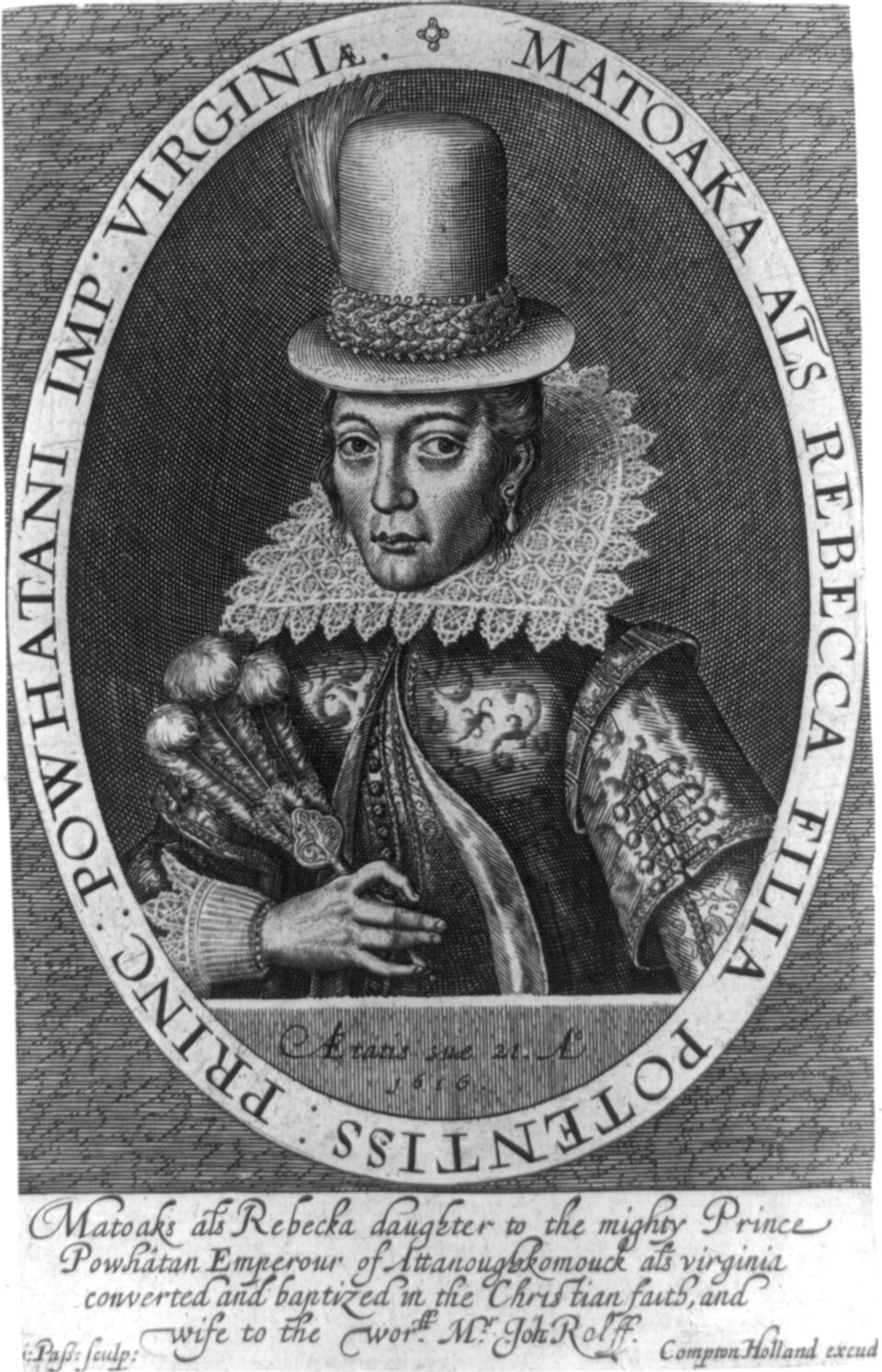
Simon van de Passe, portrait of Pocahontas (Matoaka/Rebecca Rolfe), 1616. Source: National Portrait Gallery, Smithsonian Institution (public domain).
Guided Observation
- How does Pocahontas appear in this engraving?
- How is this different from how she's usually portrayed in popular culture?
- The inscription calls her "Matoaka, alias Rebecca." What do these names tell you about her life?
Corroboration
How does this real portrait compare to the mythologized versions of Pocahontas in popular culture?
Citation
Van de Passe, Simon. "Pocahontas." 1616. National Portrait Gallery, Smithsonian Institution.
Richard Frethorne's Letter Home (1623)
Before You Read
Richard Frethorne was an English indentured servant in Virginia. He wrote this desperate letter to his parents begging them to help him. Most indentured servants could not read or write, so this letter is rare and valuable.
Loving and kind father and mother… This is to let you understand that I your child am in a most heavy case by reason of the country, [which] is such that it causeth much sickness… since I came out of the ship I never ate anything but peas, and loblollie (that is, water gruel). As for deer or venison, I never saw any since I came into this land… I have nothing to comfort me, nor is there nothing to be gotten here but sickness and death.
Vocabulary
- indentured servant — a person who agreed to work for a set number of years in exchange for passage to America
- gruel — a thin, watery porridge
- provisions — food and supplies
Sourcing Questions
- Frethorne is writing to his parents. How does that audience affect what he says?
- Is he exaggerating to get help, or is he being honest? How can you tell?
Close Reading
- What does Frethorne eat? What doesn't he eat?
- What does the phrase "sickness and death" tell you about his state of mind?
Corroboration
How does Frethorne's experience compare to John Smith's account of Jamestown?
Citation
Frethorne, Richard. "Letter to his Father and Mother." March–April 1623. In Kingsbury, Susan Myra, ed. The Records of the Virginia Company of London. Government Printing Office, 1935.