Historical Thinking Skills
As you read each source, practice these four skills:
- Sourcing Who created this? When? Why?
- Contextualization What was happening when this was created?
- Close Reading What exactly does it say? What stands out?
- Corroboration How does it compare to other sources?
Columbus's Journal (Oct 12, 1492)
Before You Read
This is Columbus's own account of his first contact with the Taíno people of the Caribbean. Pay close attention to what he notices first — and what his words reveal about his real intentions.
They… brought us parrots and balls of cotton and spears and many other things, which they exchanged for the glass beads and hawks' bells. They willingly traded everything they owned… They were well-built, with good bodies and handsome features… They do not bear arms, and do not know them, for I showed them a sword, they took it by the edge and cut themselves out of ignorance. They have no iron. Their spears are made of cane… They would make fine servants… With fifty men we could subjugate them all and make them do whatever we want.
Vocabulary
- subjugate — to bring under control by force
- exchange — to trade one thing for another
- ignorance — as Columbus uses it, a lack of knowledge about European weapons (though the Taíno had their own sophisticated knowledge)
Sourcing Questions
- Columbus is writing to the King and Queen of Spain who paid for his voyage. How might that affect what he writes?
- He calls the Taíno "ignorant" — but what evidence in his own writing shows they were skilled people?
Close Reading
- Underline every word or phrase that reveals Columbus's attitude toward the Taíno.
- What is the shift between the beginning and end of this passage?
Corroboration
How does Columbus's own journal challenge the "heroic explorer" narrative?
Citation
Columbus, Christopher. Journal of the First Voyage of Columbus. 1492. Translated by Clements R. Markham, Hakluyt Society, 1893.
Aztec Account of the Conquest (Florentine Codex)
Before You Read
Most accounts of the Spanish conquest were written by the Spanish. This is different. Aztec survivors told their side of the story to a Spanish friar who recorded it in their language (Nahuatl) and in Spanish. This passage describes smallpox hitting Tenochtitlán.
Sores erupted on our faces, our breasts, our bellies; we were covered with agonizing sores from head to foot. The illness was so dreadful that no one could walk or move… They could not get up to search for food, and everybody else was too sick to care for them, so they starved to death in their beds… They could not move; they could only lie there in their resting places and beds. They could not lie face down or roll from one side to the other. And if they moved their bodies, they screamed in pain.
Vocabulary
- epidemic — a widespread outbreak of disease
- immunity — the body's ability to resist a disease
- devastation — severe and widespread destruction
Sourcing Questions
- These words come from Aztec survivors speaking to a Spanish priest. How might both of those facts affect the account?
- Why is it important to have Indigenous accounts of the conquest?
Close Reading
- What specific physical details make this passage powerful? Why do those details matter?
Corroboration
The textbook says European diseases killed up to 90% of Indigenous populations. Does this source help you understand how that was possible?
Citation
Sahagún, Bernardino de. Florentine Codex: General History of the Things of New Spain. Book 12. c. 1577. Excerpt in León-Portilla, Miguel. The Broken Spears: The Aztec Account of the Conquest of Mexico. Beacon Press, 1962.
Theodor de Bry Engraving of Columbus Landing (1594)
Before You Read
This famous engraving was made by Theodor de Bry, a European artist who never visited the Americas. He created this image over 100 years after Columbus landed. Notice: How does he draw the Europeans? How does he draw the Indigenous people? What story is the image trying to tell?
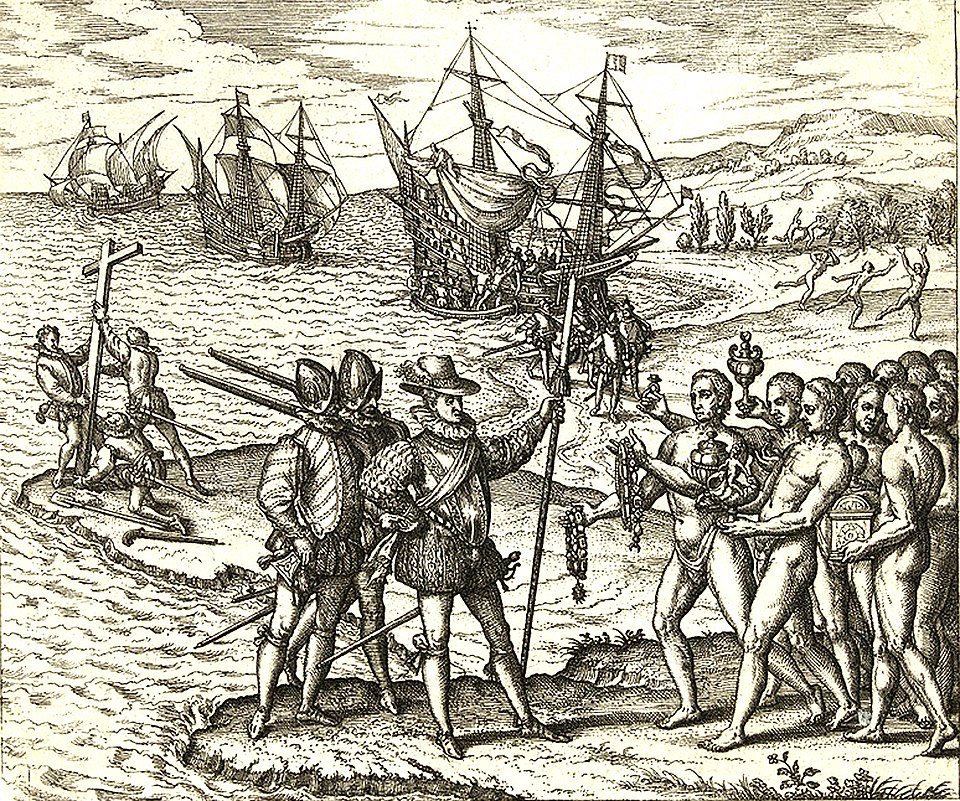
Theodor de Bry, "Columbus Landing on Hispaniola," 1594. Source: Wikimedia Commons (public domain).
Guided Observation
- Who appears powerful in this image? How can you tell?
- What are the Indigenous people doing?
- De Bry never went to the Americas. What details might he have gotten wrong?
- What story does this image tell — and whose story is it?
Corroboration
How does this image compare to Columbus's own journal entry? Do they tell the same story?
Citation
De Bry, Theodor. "Columbus Landing on Hispaniola." 1594. Library of Congress.
Olaudah Equiano — The Middle Passage (1789)
Before You Read
Olaudah Equiano was kidnapped from his home in present-day Nigeria at age 11 and forced onto a slave ship crossing the Atlantic. He eventually bought his freedom and wrote this autobiography to support the movement to abolish slavery. This passage describes conditions on the ship.
The closeness of the place, and the heat of the climate, added to the number in the ship, which was so crowded that each had scarcely room to turn himself, almost suffocated us. This produced copious perspirations, so that the air soon became unfit for respiration, from a variety of loathsome smells, and brought on a sickness among the slaves, of which many died… The shrieks of the women, and the groans of the dying, rendered the whole a scene of horror almost inconceivable.
Vocabulary
- suffocated — unable to breathe
- copious — large in quantity
- respiration — breathing
- loathsome — disgusting
- rendered — made or turned into
- inconceivable — impossible to imagine
Sourcing Questions
- Equiano wrote this as an adult looking back on childhood. How might that shape his writing?
- He published this book to convince people to end slavery. Does that make it less trustworthy, or more powerful?
Close Reading
- Which sensory details (sight, smell, sound) does Equiano use? Why are they effective?
- He says the scene was "almost inconceivable." What does that word choice tell you?
Corroboration
The textbook discusses the Middle Passage in general terms. How does Equiano's personal account change your understanding?
Citation
Equiano, Olaudah. The Interesting Narrative of the Life of Olaudah Equiano. 1789.