Historical Thinking Skills
As you read each source, practice these four skills:
- Sourcing Who created this? When? Why?
- Contextualization What was happening when this was created?
- Close Reading What exactly does it say? What stands out?
- Corroboration How does it compare to other sources?
Haudenosaunee (Iroquois) Creation Story
Before You Read
The Haudenosaunee (Iroquois) Confederacy is one of the oldest democracies in the world. Their creation story explains how the world was formed on the back of a great turtle — which is why some Indigenous peoples call North America "Turtle Island." This version was recorded by Haudenosaunee people in the early 1900s, but the story is thousands of years old.
In the beginning, there was no earth, only water and sky. In the Sky World above, a great tree stood at the center. Sky Woman fell through a hole near the great tree. The birds saw her falling and flew up to catch her, spreading their wings to slow her descent. The great sea turtle rose from the waters and offered his back as a resting place. The animals dove deep into the water, searching for earth. The muskrat finally brought up a small handful of mud and placed it on the turtle's back. Sky Woman walked in a circle on the turtle's shell, and as she walked, the earth grew and grew — and that is how the world began.
Vocabulary
- cosmology — the study of the origin of the universe
- confederacy — a union of groups joined together for a common purpose
- oral tradition — stories, histories, and knowledge passed down through spoken word rather than writing
Sourcing Questions
- This story was passed down orally for generations before being written down. How might that affect what we're reading?
- Why might Indigenous peoples call North America "Turtle Island"?
Close Reading
- What role do animals play in this story?
- How does this creation story compare to other creation stories you know?
Corroboration
How does this source challenge or support the idea that Indigenous peoples had complex belief systems before European contact?
Citation
Hewitt, J.N.B. "Iroquoian Cosmology." Twenty-First Annual Report of the Bureau of American Ethnology. Government Printing Office, 1903.
Monks Mound at Cahokia: An 1882 Engraving and a Modern Photograph
Before You Read
Cahokia, located near present-day St. Louis, Missouri, was the largest city in North America before European contact. At its peak around 1100 CE, it had a population of 10,000–20,000 people — larger than London at the same time. Its central feature was Monks Mound, a massive earthen pyramid covering 14 acres at its base, larger than the Great Pyramid of Egypt in footprint. Below are two views of the mound: an engraving published in 1882, and a photograph taken in 2007. Both were made centuries after Cahokia was abandoned.
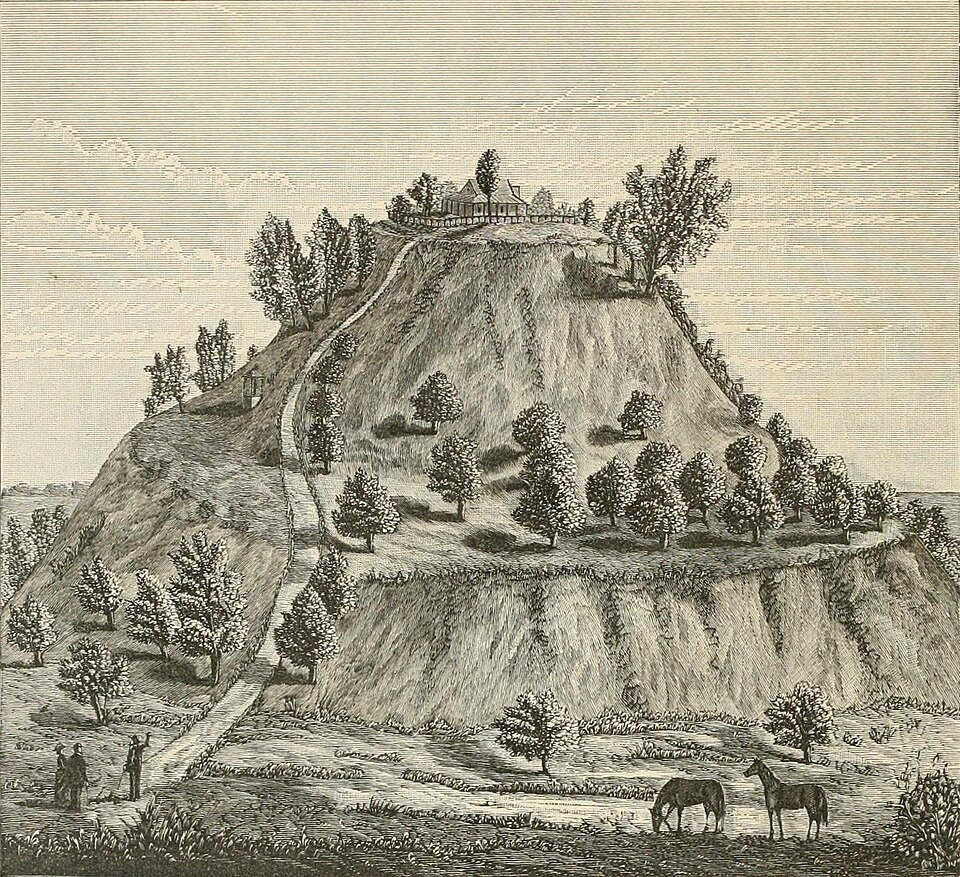
Monks Mound, Cahokia, Illinois. Engraving published in History of Madison County, Illinois (W. R. Brink & Co., 1882). Source: Wikimedia Commons (public domain).
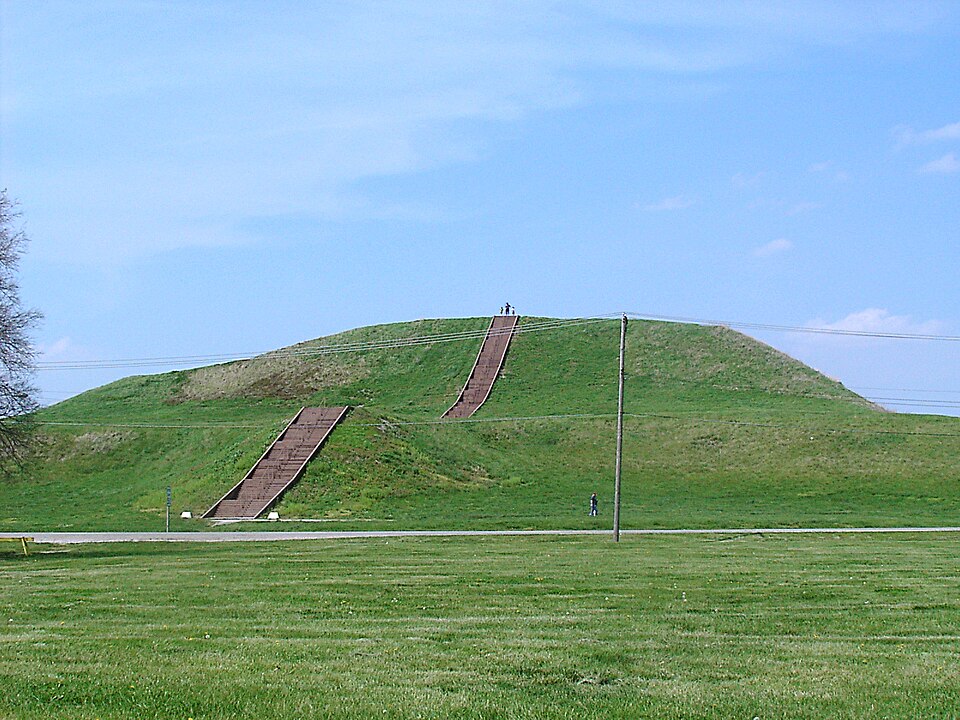
Monks Mound today. The largest pre-Columbian earthwork in the Americas. Photo: Skubasteve834, 2007, via Wikimedia Commons (CC BY-SA 3.0).
Sourcing Questions
- The engraving was made in 1882 — more than 500 years after Cahokia was abandoned. What do you see on top of the mound that would not have been there when Cahokia was a living city?
Guided Observation
- How large does the mound appear compared to the human figures in each image?
- What does the flat top suggest about how it was used?
- What kind of labor would it take to build something this large without metal tools or wheels?
Corroboration
The textbook says Indigenous societies were "sophisticated civilizations." Do these images support that claim? Where do the 1882 engraving and the modern photograph agree — and where do they differ? What additional evidence would you want?
Citation
"Monks Mound." Engraving in History of Madison County, Illinois. W. R. Brink & Co., 1882. Photograph by Skubasteve834, 2007 (CC BY-SA 3.0). Both via Wikimedia Commons.
View the original engraving → View the original photograph →
Bernal Díaz del Castillo Describes Tenochtitlán (1568)
Before You Read
When Spanish conquistadors first saw the Aztec capital of Tenochtitlán in 1519, they couldn't believe their eyes. Bernal Díaz del Castillo was a soldier who was there. He wrote this description decades later, still amazed by what he had seen. Tenochtitlán had a population of over 200,000 — five times larger than London at the time.
We were amazed and said that it was like the enchantments they tell of in the legend of Amadís, on account of the great towers and buildings rising from the water, and all built of stone. And some of our soldiers even asked whether the things that we saw were not a dream… I do not know how to describe it, seeing things as we did that had never been heard of or seen before, not even dreamed about… When we entered the great market place, the multitude of people and the quantities of merchandise amazed us. The noise and hum of voices could have been heard more than a league off.
Vocabulary
- enchantment — a feeling of wonder and delight, as if under a magical spell
- conquistador — a Spanish soldier who conquered lands in the Americas
- causeways — raised roads built across water or wetlands
Sourcing Questions
- Díaz wrote this almost 50 years after he saw Tenochtitlán. How might time affect his memory?
- Why does he compare it to legends and dreams?
Close Reading
- What specific details does Díaz mention that tell you about the city's sophistication?
Corroboration
How does Díaz's description support or complicate the chapter's argument about Indigenous civilizations?
Citation
Díaz del Castillo, Bernal. The True History of the Conquest of New Spain. 1568. Translated by Alfred Percival Maudslay, Hakluyt Society, 1908.
Ojibwe Birch Bark Boxes
Before You Read
Indigenous peoples of the Great Lakes and Northeast have worked with birch bark for thousands of years, shaping it into canoes, containers, and shelter coverings. Birch bark is waterproof, lightweight, and flexible — a brilliant engineering choice. These decorated boxes were made by an Ojibwe artist sometime after 1865. The boxes are much newer than Cahokia or Tenochtitlán, but the techniques behind them are ancient — a living technology passed down and adapted across many generations, including after European contact.
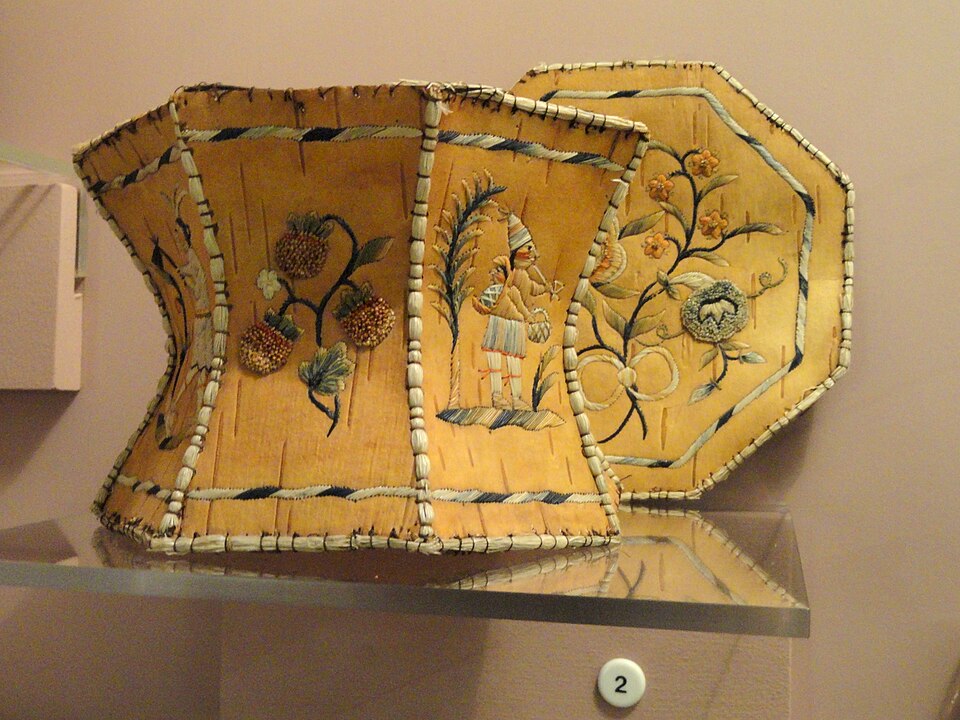
Birch bark boxes, probably southeastern Ojibwe, made after 1865. Peabody Museum of Archaeology and Ethnology, Harvard University. Photo: Daderot, via Wikimedia Commons (CC0).
Sourcing Questions
- These boxes were made after 1865, long after European contact. Why might historians still use them as evidence about much older Indigenous technology? What are the limits of doing that?
Guided Observation
- What materials do you see?
- What does the decoration tell you about the maker?
- How does this object challenge the idea that Indigenous peoples lived "simple" lives?
Corroboration
What does this artifact tell us about Indigenous technology and artistry that written sources might miss?
Citation
Box (birch bark), probably southeastern Ojibwe, post-1865. Peabody Museum of Archaeology and Ethnology, Harvard University.