Historical Thinking Skills
As you read each source, practice these four skills:
- Sourcing Who created this? When? Why?
- Contextualization What was happening when this was created?
- Close Reading What exactly does it say? What stands out?
- Corroboration How does it compare to other sources?
The Thirteenth Amendment to the U.S. Constitution
Before You Read
The Emancipation Proclamation (1863) was a wartime order that only applied to Confederate states. To permanently end slavery everywhere in the United States, Congress passed the Thirteenth Amendment. It was ratified in December 1865, eight months after the war ended and Lincoln's assassination.
Section 1. Neither slavery nor involuntary servitude, except as a punishment for crime whereof the party shall have been duly convicted, shall exist within the United States, or any place subject to their jurisdiction.
Section 2. Congress shall have power to enforce this article by appropriate legislation.
Vocabulary
- involuntary servitude — being forced to work against your will
- ratified — formally approved (three-fourths of states must agree to ratify an amendment)
- jurisdiction — the area over which a government has legal authority
- duly convicted — found guilty through proper legal process
Sourcing Questions
- Why was a constitutional amendment necessary if the Emancipation Proclamation already existed?
- The amendment was ratified without the consent of most former Confederate states. Does that matter?
Close Reading
- The amendment bans slavery "except as a punishment for crime." Why is that exception significant? How might it be abused?
- The amendment says what cannot exist. What does it not say about citizenship, voting, or equality?
- Section 2 gives Congress "power to enforce." Why was that included?
Corroboration
Compare this to the Fugitive Slave Act from Chapter 13. How has the power of the federal government changed — and whose freedom is it now protecting?
Citation
"Amendment XIII." U.S. Constitution. Ratified 6 Dec. 1865. National Archives.
Jourdon Anderson's Letter to His Former Enslaver
Before You Read
Jourdon Anderson was formerly enslaved by Colonel P.H. Anderson in Big Spring, Tennessee. After the war, his former enslaver wrote asking Jourdon to come back and work. Jourdon, now living as a free man in Dayton, Ohio, dictated this extraordinary reply. The letter was published in a Cincinnati newspaper and became famous.
Sir: I got your letter, and was glad to find that you had not forgotten Jourdon, and that you wanted me to come back and live with you again, promising to do better for me than anybody else can… I want to know particularly what the good chance is you propose to give me. I am doing tolerably well here. I get twenty-five dollars a month, with victuals and clothing; have a comfortable home for Mandy — the folks call her Mrs. Anderson — and the children… Mandy says she would be afraid to go back without some proof that you were disposed to treat us justly and kindly; and we have concluded to test your sincerity by asking you to send us our wages for the time we served you. This will make us forget and forgive old scores… I served you faithfully for thirty-two years, and Mandy twenty years. At twenty-five dollars a month for me, and two dollars a week for Mandy, our earnings would amount to eleven thousand six hundred and eighty dollars.
Vocabulary
- tolerably — fairly, reasonably well
- victuals — food and provisions
- disposed — willing or inclined
- sincerity — honesty and genuineness of intentions
Sourcing Questions
- Jourdon dictated this letter (he could not write). It was published in a newspaper. How might the audience affect the tone?
- Why would a formerly enslaved person respond to his former enslaver at all?
Close Reading
- Jourdon asks for $11,680 in back wages. Is he seriously expecting payment, or is he making a point? What point?
- "The folks call her Mrs. Anderson" — why does Jourdon include this detail?
- What is the tone of this letter? Angry? Humorous? Dignified? Find evidence to support your answer.
Corroboration
This letter shows one person's experience of freedom. How does it compare to the promises of the 13th Amendment (Source 15.1)? Is freedom the same as equality?
Citation
Anderson, Jourdon. "Letter to Colonel P.H. Anderson." 7 Aug. 1865. Cincinnati Commercial, 22 Aug. 1865.
Mississippi Black Codes
Before You Read
After the war, Southern states passed laws called "Black Codes" to control the lives of formerly enslaved people. Mississippi's codes were among the harshest. They required Black people to sign yearly labor contracts, banned them from owning farmland, and allowed courts to arrest and fine Black people for being "vagrants" — then force them to work to pay off the fines.
Sec. 2. All freedmen, free negroes and mulattoes in this State, over the age of eighteen years, found on the second Monday in January, 1866, or thereafter, with no lawful employment or business… shall be deemed vagrants, and on conviction thereof shall be fined… not exceeding fifty dollars… and imprisoned… not exceeding ten days.
Sec. 5. If any freedman, free negro, or mulatto… shall fail or refuse to pay any tax levied… it shall be lawful for any person to arrest said freedman… The sheriff shall hire out said freedman to any person who will pay said tax.
Vocabulary
- vagrant — a person without a home or job (used as an excuse to arrest people)
- mulatto — an outdated and offensive term for a person of mixed Black and white ancestry
- hire out — to force someone to work for another person
- levied — imposed or charged (as a tax or fine)
Sourcing Questions
- Who wrote these laws? Who benefits from them?
- These laws were passed just months after the 13th Amendment. What does that timing tell you?
Close Reading
- Section 2 says people without jobs can be arrested. How could this be used to target formerly enslaved people specifically?
- Section 5 says a sheriff can "hire out" someone who can't pay a tax. How is this different from slavery? Is it?
- The law never uses the word "slavery." Why not?
Corroboration
The 13th Amendment banned slavery "except as a punishment for crime." How do the Black Codes exploit that loophole?
Citation
"An Act to Confer Civil Rights on Freedmen." Laws of the State of Mississippi, 1865. Mississippi Department of Archives and History.
Thomas Nast, "Worse Than Slavery"
Before You Read
Thomas Nast was the most famous political cartoonist in America. This cartoon was published during Reconstruction, as white supremacist groups like the Ku Klux Klan and the White League used violence to terrorize Black Southerners and their allies. By 1874, many Northerners were growing tired of Reconstruction, and support for protecting Black rights was fading.
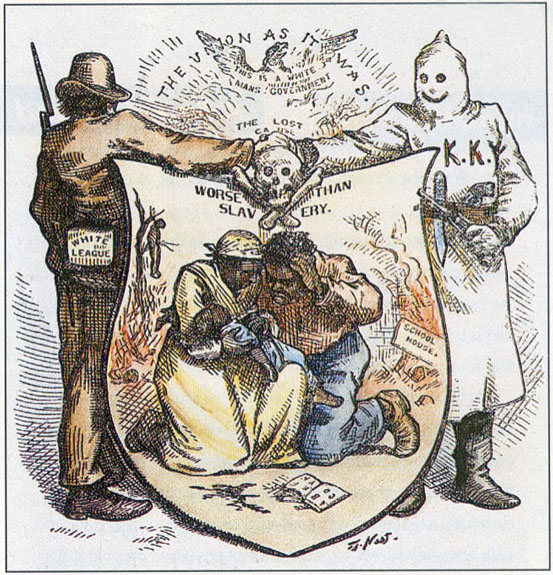
Thomas Nast, "Worse Than Slavery," Harper's Weekly, October 24, 1874. Source: Library of Congress (public domain).
Guided Observation
- Who are the two figures shaking hands? What do they represent?
- What scenes do you notice in the background? What story do they tell?
- The title says "Worse Than Slavery." What is Nast arguing is worse than slavery?
Sourcing Questions
- Nast published this in Harper's Weekly, a Northern magazine. Who is his audience?
- What does he want his audience to do or feel?
Corroboration
Compare this cartoon to the Mississippi Black Codes (Source 15.3). Does the cartoon accurately represent what was happening in the South during Reconstruction?
Citation
Nast, Thomas. "Worse Than Slavery." Harper's Weekly, 24 Oct. 1874. Library of Congress.