Historical Thinking Skills
As you read each source, practice these four skills:
- Sourcing Who created this? When? Why?
- Contextualization What was happening when this was created?
- Close Reading What exactly does it say? What stands out?
- Corroboration How does it compare to other sources?
The Emancipation Proclamation
Before You Read
By 1862, Lincoln had decided that freeing enslaved people in Confederate states would weaken the Southern war effort and give the Union a moral cause. The Emancipation Proclamation did not free enslaved people in border states that stayed loyal to the Union — only those in states that were in rebellion. It also opened the door for Black men to serve in the Union Army.
That on the first day of January, in the year of our Lord one thousand eight hundred and sixty-three, all persons held as slaves within any State or designated part of a State, the people whereof shall then be in rebellion against the United States, shall be then, thenceforward, and forever free; and the Executive Government of the United States, including the military and naval authority thereof, will recognize and maintain the freedom of such persons… And I further declare and make known, that such persons of suitable condition, will be received into the armed service of the United States.
Vocabulary
- proclamation — an official public announcement
- thenceforward — from that time on
- rebellion — armed resistance against an established government
- executive — the branch of government headed by the president
Sourcing Questions
- Why did Lincoln issue this as a military order rather than ask Congress to pass a law?
- The Proclamation only freed enslaved people in states "in rebellion." Why not in border states too?
Close Reading
- What does "thenceforward, and forever free" mean? Why is the word "forever" important?
- The last sentence invites Black men to join the military. Why would Lincoln include that in the same document?
- Does this document actually end slavery in America? Why or why not?
Corroboration
Frederick Douglass called the Emancipation Proclamation "the first step on the part of the nation in its departure from the thraldom of ages." Do you agree it was only a "first step"? What more was needed?
Citation
Lincoln, Abraham. "The Emancipation Proclamation." 1 Jan. 1863. National Archives.
Sullivan Ballou's Letter to His Wife
Before You Read
Sullivan Ballou was a Union officer from Rhode Island. He wrote this letter to his wife Sarah one week before the First Battle of Bull Run. In it, he tries to explain why he is willing to die for his country, while also expressing his deep love for his family. He was killed in battle on July 21, 1861.
My very dear Sarah: The indications are very strong that we shall move in a few days — perhaps tomorrow. Lest I should not be able to write you again, I feel impelled to write lines that may fall under your eye when I shall be no more… I have no misgivings about, or lack of confidence in, the cause in which I am engaged, and my courage does not halt or falter. I know how strongly American Civilization now leans upon the triumph of the Government… Sarah, my love for you is deathless, it seems to bind me to you with mighty cables that nothing but Omnipotence could break; and yet my love of Country comes over me like a strong wind and bears me irresistibly on with all these chains to the battlefield.
Vocabulary
- impelled — driven or pushed to do something
- misgivings — feelings of doubt or worry
- omnipotence — unlimited, all-powerful force (often referring to God)
- irresistibly — in a way that cannot be resisted or stopped
Sourcing Questions
- Ballou is writing to his wife, knowing he might die. How does that shape what he says?
- This is a private letter. Does that make it more or less reliable than a public speech?
Close Reading
- Ballou describes a conflict between love of family and love of country. Which side wins?
- He says "American Civilization" depends on the Union winning. What does he mean?
- How does his use of metaphor ("mighty cables," "strong wind") help you understand his feelings?
Corroboration
Ballou fought for the Union but does not mention slavery. Does that change how you understand why soldiers fought? How does this compare to Lincoln's stated reasons for the war?
Citation
Ballou, Sullivan. "Letter to Sarah Ballou." 14 July 1861. Abraham Lincoln Papers, Library of Congress.
The Gettysburg Address
Before You Read
The Battle of Gettysburg (July 1–3, 1863) was the bloodiest battle of the Civil War, with over 50,000 casualties. Four months later, Lincoln traveled to Gettysburg, Pennsylvania, to dedicate a cemetery for the fallen soldiers. His speech lasted about two minutes, but it became one of the most famous addresses in American history. In it, he redefined what the war was about.
Four score and seven years ago our fathers brought forth on this continent, a new nation, conceived in Liberty, and dedicated to the proposition that all men are created equal. Now we are engaged in a great civil war, testing whether that nation, or any nation so conceived and so dedicated, can long endure… It is rather for us to be here dedicated to the great task remaining before us — that from these honored dead we take increased devotion to that cause for which they gave the last full measure of devotion — that we here highly resolve that these dead shall not have died in vain — that this nation, under God, shall have a new birth of freedom — and that government of the people, by the people, for the people, shall not perish from the earth.
Vocabulary
- four score — eighty (a "score" is twenty); refers to 1776
- conceived — created or brought into being
- proposition — an idea or statement put forward
- devotion — love, loyalty, and dedication
- perish — to die or come to an end
Sourcing Questions
- Lincoln is speaking at a cemetery dedication. How does the setting shape his message?
- "Four score and seven years ago" points to 1776, not 1787 (the Constitution). Why does Lincoln choose the Declaration of Independence as the nation's founding?
Close Reading
- Lincoln says the nation is "testing whether that nation… can long endure." What is being tested?
- What does "a new birth of freedom" mean? How is it different from the original birth of freedom in 1776?
- "Government of the people, by the people, for the people" — why does Lincoln repeat this structure three times?
Corroboration
Compare this to the "House Divided" speech from Chapter 13. How has Lincoln's message about the war changed between 1858 and 1863?
Citation
Lincoln, Abraham. "The Gettysburg Address." 19 Nov. 1863. Cornell University Library.
Contraband Camp at Richmond, Virginia
Before You Read
During the Civil War, thousands of enslaved people fled to Union Army lines seeking freedom. The military called them "contrabands" — enemy property seized in wartime. Contraband camps sprang up near Union forts and cities. Conditions were often harsh, but for many, these camps represented the first taste of freedom. Some camps became self-governing communities with schools, churches, and hospitals.
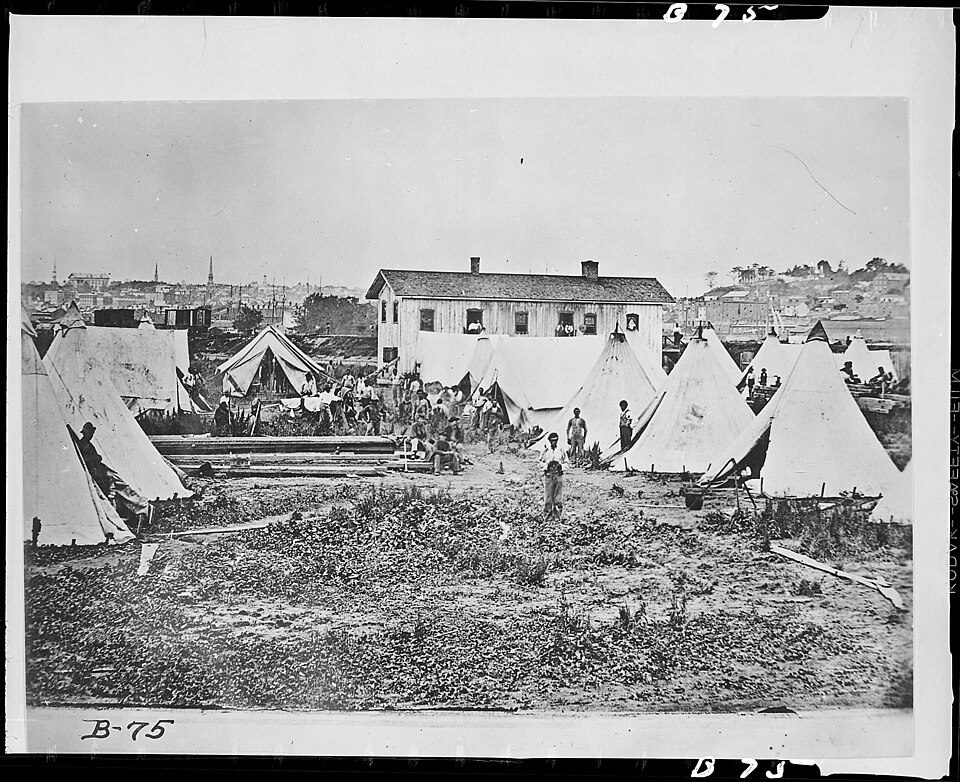
"Contraband Camp, Richmond, Virginia," c. 1865. Source: Library of Congress (public domain).
Guided Observation
- What do you notice about the living conditions in the photograph?
- Who do you see in the image? Men, women, children? What does that tell you?
- The people are looking at the camera. What might they be thinking or feeling?
Corroboration
The Emancipation Proclamation (Source 14.1) declared these people free. But look at the conditions in the photograph. What is the gap between freedom on paper and freedom in reality?
Citation
"Contraband Camp, Richmond, Virginia." c. 1865. Prints and Photographs Division, Library of Congress.