Historical Thinking Skills
As you read each source, practice these four skills:
- Sourcing Who created this? When? Why?
- Contextualization What was happening when this was created?
- Close Reading What exactly does it say? What stands out?
- Corroboration How does it compare to other sources?
Washington's Letter About Shays's Rebellion
Before You Read
George Washington had retired to his farm at Mount Vernon. When he heard about Shays's Rebellion, he was alarmed enough to come out of retirement — eventually agreeing to preside over the Constitutional Convention.
For God's sake, tell me what is the cause of all these commotions? Do they proceed from licentiousness, British influence disseminated by the Tories, or real grievances which admit of redress? If the latter, why were they delayed till the public mind had become so much agitated? If the former, why are not the proper remedies applied?
Vocabulary
- commotions — disturbances or uprisings
- licentiousness — disregard for rules or law
- Tories — colonists who had supported Britain
- grievances — complaints about unfair treatment
- redress — remedy or correction
- agitated — disturbed or upset
Sourcing Questions
- Washington is writing privately to a friend. How might that affect his honesty?
- Why is it significant that this rebellion alarmed even George Washington?
Close Reading
- Washington asks whether the rebels have "real grievances." What does his uncertainty tell you?
Corroboration
How does Washington's concern connect to the textbook's description of why the Constitution was created?
Citation
Washington, George. "Letter to David Humphreys." 26 Dec. 1786. Founders Online, National Archives.
Three-Fifths Clause
Before You Read
The Constitution never uses the word 'slave.' But this clause — counting enslaved people as three-fifths of a person for representation — is one of the most important and most disturbing compromises in American history.
Representatives and direct Taxes shall be apportioned among the several States… according to their respective Numbers, which shall be determined by adding to the whole Number of free Persons, including those bound to Service for a Term of Years, and excluding Indians not taxed, three fifths of all other Persons.
Vocabulary
- apportioned — divided or distributed
- respective — belonging to each individually
- bound to Service — indentured servants
Sourcing Questions
- Why doesn't the Constitution use the word "slave"?
- Who benefited from this compromise — the North or the South?
Close Reading
- Who are "all other Persons"?
- Enslaved people couldn't vote. So who actually benefited from counting them?
- "Indians not taxed" are completely excluded. What does that reveal?
Corroboration
How does this clause connect to the Virginia Slave Codes from Chapter 4?
Citation
"The Constitution of the United States." 1787. Article I, Section 2. National Archives.
Federalist No. 10 — James Madison
Before You Read
James Madison wrote this essay to convince Americans to ratify the Constitution. His argument: in a large republic, no single 'faction' (interest group) can dominate everyone else. It's considered one of the most important political essays ever written.
By a faction, I understand a number of citizens… who are united and actuated by some common impulse of passion, or of interest, adverse to the rights of other citizens, or to the permanent and aggregate interests of the community… The smaller the society, the fewer probably will be the distinct parties and interests… and the smaller the compass within which they are placed, the more easily will they concert and execute their plans of oppression. Extend the sphere, and you take in a greater variety of parties and interests; you make it less probable that a majority of the whole will have a common motive to invade the rights of other citizens.
Vocabulary
- faction — a group united by shared interests, often against others
- actuated — motivated or driven
- adverse — harmful or opposed to
- aggregate — combined, total
- oppression — cruel or unjust use of power
Sourcing Questions
- Madison is trying to convince people to ratify the Constitution. How might that goal shape his argument?
- Is he describing how government works, or how he hopes it will work?
Close Reading
- In your own words, what is Madison's argument? Why does he think a big country is actually safer than a small one?
Corroboration
Does Madison's argument hold up? Can you think of times in American history when factions DID dominate?
Citation
Madison, James. "Federalist No. 10." The Daily Advertiser, 22 Nov. 1787.
"Providential Detection" Cartoon
Before You Read
During the vicious election of 1800, Federalists created this cartoon showing Thomas Jefferson about to burn the Constitution on an altar labeled 'Gallic Despotism' (French tyranny). An eagle — representing America — stops him. Campaign attacks in 1800 were every bit as vicious as today.
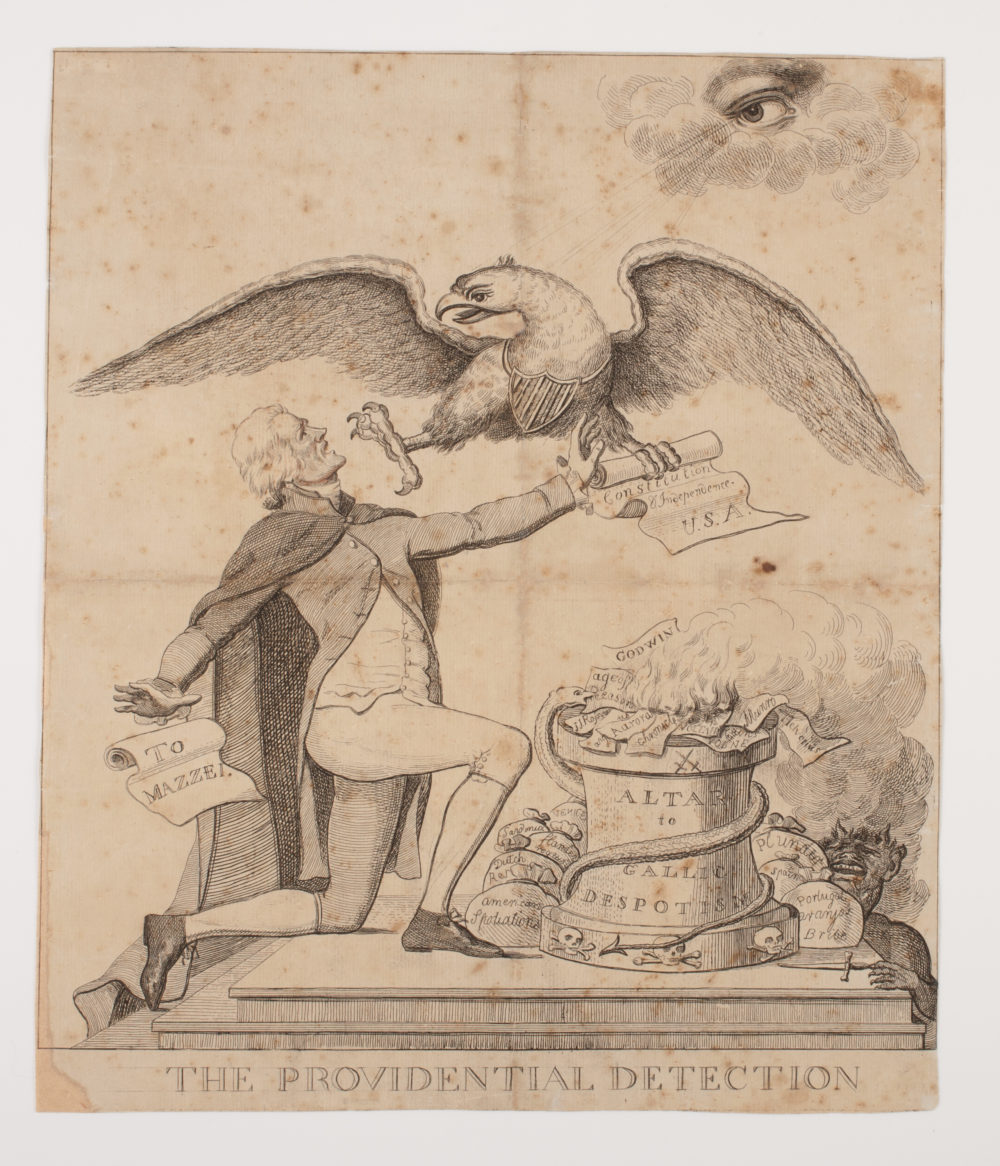
"The Providential Detection," c. 1800. Source: American Antiquarian Society (public domain).
Sourcing Questions
- This cartoon was created by Federalists during the election of 1800. How does that context shape its message?
Guided Observation
- What is Jefferson holding? What is he about to do with it?
- What does the eagle represent?
- What message is the artist sending voters?
- Is this "fake news" from 1800? How is it similar to or different from modern political attacks?
Corroboration
The textbook describes the election of 1800 as the nastiest in history. Does this cartoon support that claim?
Citation
"Providential Detection." c. 1800. American Antiquarian Society. Wikimedia Commons.