Historical Thinking Skills
As you read each source, practice these four skills:
- Sourcing Who created this? When? Why?
- Contextualization What was happening when this was created?
- Close Reading What exactly does it say? What stands out?
- Corroboration How does it compare to other sources?
Jefferson's First Inaugural Address
Before You Read
After the most vicious election in American history, Jefferson tried to heal the nation. His opening line is one of the most important sentences in the history of democracy.
We are all Republicans, we are all Federalists. If there be any among us who would wish to dissolve this Union or to change its republican form, let them stand undisturbed as monuments of the safety with which error of opinion may be tolerated where reason is left free to combat it.
Vocabulary
- dissolve — to break apart
- republican form — a government where people elect representatives
- tolerated — allowed or accepted
- combat — to fight against
Sourcing Questions
- Jefferson just won a bitter election. Why would he start by reaching out to the other side?
- Is this sincere, or is it political strategy?
Close Reading
- What does Jefferson mean by "error of opinion may be tolerated where reason is left free to combat it"? How is this different from the Sedition Act?
Corroboration
How does this speech connect to the "Providential Detection" cartoon from the previous chapter?
Citation
Jefferson, Thomas. "First Inaugural Address." 4 Mar. 1801. The Avalon Project, Yale Law School.
Tecumseh's Speech to Governor Harrison
Before You Read
Tecumseh, a Shawnee leader, was building a confederation of Native nations to resist American expansion. He met with Governor William Henry Harrison at Vincennes and delivered this blunt warning.
The way, and the only way, to check and to stop this evil, is for all the red men to unite in claiming a common and equal right in the land, as it was at first, and should be yet; for it was never divided, but belongs to all for the use of each… Sell a country! Why not sell the air, the clouds and the great sea, as well as the earth?
Vocabulary
- confederation — an alliance of groups joined together
- cede — to give up territory
- sovereignty — supreme power or authority over a territory
Sourcing Questions
- This speech was recorded by Harrison's secretary, not by Tecumseh. How might that affect accuracy?
- Why would Tecumseh speak so directly to an American governor?
Close Reading
- What is Tecumseh's argument about land ownership?
- "Sell a country! Why not sell the air?" — What does this reveal about different concepts of land?
Corroboration
How does Tecumseh's speech connect to the Indian Removal that will come in Chapter 9?
Citation
Tecumseh. "Speech to Governor Harrison." Aug. 1810. As recorded in Messages and Letters of William Henry Harrison. Vol. 1. Edited by Logan Esarey, Indiana Historical Commission, 1922.
Benjamin Banneker's Letter to Jefferson
Before You Read
Benjamin Banneker was a free Black mathematician and astronomer who helped survey the land for Washington, D.C. He wrote this extraordinary letter directly challenging Thomas Jefferson's racist views — using Jefferson's own words against him.
Sir, I freely and cheerfully acknowledge, that I am of the African race… Sir, suffer me to recall to your mind that time, in which the arms and tyranny of the British crown were exerted, with every powerful effort, in order to reduce you to a state of servitude… You were then impressed with proper ideas of the great violation of liberty… but, Sir, how pitiable is it to reflect, that although you were so fully convinced of the benevolence of the Father of Mankind… that you should at the same time counteract his mercies, in detaining by fraud and violence so numerous a part of my brethren, under groaning captivity and cruel oppression.
Vocabulary
- servitude — the condition of being enslaved or forced to serve
- benevolence — kindness, goodness
- counteract — to work against
- brethren — brothers, fellow people
- captivity — imprisonment
Sourcing Questions
- What courage did it take for a Black man in 1791 to write this letter to one of the most powerful white politicians in America?
- Is Banneker being respectful or confrontational? Can he be both?
Close Reading
- Banneker quotes the ideas of the Declaration of Independence back to Jefferson. What is he arguing?
- What does the word "pitiable" reveal about Banneker's attitude toward Jefferson?
Corroboration
How does this letter connect to the Declaration of Independence and the Three-Fifths Clause?
Citation
Banneker, Benjamin. "Letter to Thomas Jefferson." 19 Aug. 1791. Founders Online, National Archives.
"Bombardment of Fort McHenry"
Before You Read
This image depicts the British bombardment of Fort McHenry in Baltimore harbor on September 13–14, 1814. Francis Scott Key watched this battle from a ship and wrote 'The Star-Spangled Banner' about the American flag that was still flying the next morning.
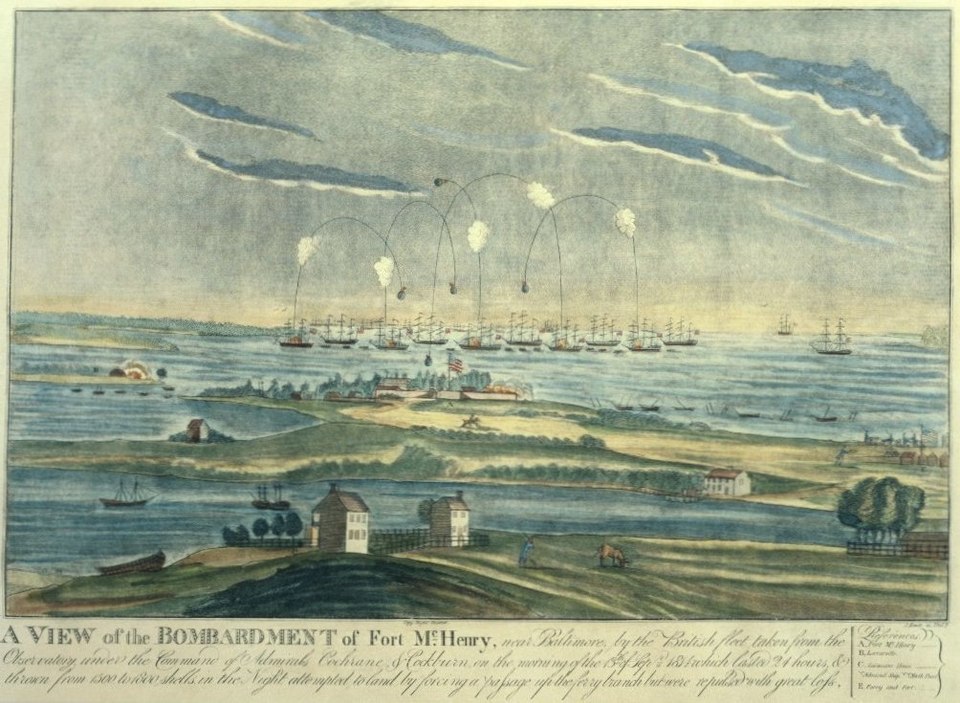
John Bower, "A View of the Bombardment of Fort McHenry," c. 1814. Source: Library of Congress (public domain).
Sourcing Questions
- This print was created around the time of the battle. How might the artist's patriotism shape the depiction?
Guided Observation
- What details show the intensity of the bombardment?
- Where would Francis Scott Key have been watching from?
- Why would seeing the flag still flying the next morning have been so emotional?
Corroboration
How does this image help you understand the emotions behind "The Star-Spangled Banner"?
Citation
Bower, John. "A View of the Bombardment of Fort McHenry." c. 1814. Library of Congress.