Historical Thinking Skills
As you read each source, practice these four skills:
- Sourcing Who created this? When? Why?
- Contextualization What was happening when this was created?
- Close Reading What exactly does it say? What stands out?
- Corroboration How does it compare to other sources?
Lowell Mill Girl Letter
Before You Read
Thousands of young women left farms to work in the textile mills of Lowell, Massachusetts. They worked 12–14 hour days, six days a week. Some wrote about their experiences in a factory magazine called The Lowell Offering. Their accounts range from optimistic to desperate.
At first the hours seemed very long, but I was told that I should get accustomed to them; and when I heard the girls singing, I supposed they were contented and happy. But as soon as I was able to understand them, I found they were singing to keep from falling asleep. The noise of the looms was deafening; you could not hear a person who was speaking to you unless they put their mouth close to your ear… We went in at five in the morning and worked until seven at night.
Vocabulary
- accustomed — used to
- contented — satisfied
- looms — machines for weaving cloth
- deafening — extremely loud
Sourcing Questions
- The Lowell Offering was partly funded by the mill owners. How might that affect what the writers said? Would they feel free to complain?
Close Reading
- What is the difference between what the narrator first thought and what she discovered?
- What specific details show how hard the work was?
Corroboration
How does this account compare to the textbook's description of factory life?
Citation
The Lowell Offering: Writings by New England Mill Women, 1840–1845.
Charles Dickens Describes Lowell
Before You Read
Charles Dickens, the famous English novelist, visited the Lowell mills in 1842 and wrote about what he saw. Compare his account — as an outsider — to the mill girls' own words.
These girls… were all well dressed. They had serviceable bonnets, good warm cloaks, and shawls… They were healthy in appearance, many of them remarkably so, and had the manners and deportment of young women; not of degraded brutes of burden… The rooms in which they worked were as well ordered as themselves. In the windows of some there were green plants, which were trained to shade the glass.
Vocabulary
- deportment — behavior and manners
- degraded — lowered in dignity or quality
- brutes of burden — animals used for heavy labor
- serviceable — practical and useful
Sourcing Questions
- Dickens is a famous foreign visitor. How might the mill owners have prepared for his visit?
- Would he have seen the worst conditions, or a sanitized version?
Close Reading
- What specific details does Dickens notice?
- He says the girls are "not degraded brutes of burden." What is he comparing them to?
Corroboration
How does Dickens's description compare to the mill girl's own account? Who do you trust more?
Citation
Dickens, Charles. American Notes for General Circulation. 1842. Chapter IV.
Erie Canal Song
Before You Read
The Erie Canal, completed in 1825, was one of the greatest engineering projects in American history. It connected the Great Lakes to the Atlantic Ocean and transformed the American economy. This popular song captures the life of canal workers and mule drivers.
I've got a mule, her name is Sal, / Fifteen miles on the Erie Canal. / She's a good old worker and a good old pal, / Fifteen miles on the Erie Canal. / We've hauled some barges in our day, / Filled with lumber, coal, and hay, / And we know every inch of the way / From Albany to Buffalo. / Low bridge, everybody down! / Low bridge, for we're coming to a town! / And you'll always know your neighbor, / You'll always know your pal, / If you ever navigated on the Erie Canal.
Vocabulary
- mule — an animal used to pull canal boats along the towpath
- barge — a flat-bottomed boat for carrying cargo
- navigated — traveled or steered along a route
Sourcing Questions
- This song was written long after the canal era. Does that make it less useful as a historical source? What can songs tell us that other sources can't?
Close Reading
- What does this song tell you about the daily life of canal workers?
- What goods are being transported? What does that tell you about the economy?
Corroboration
How does this song connect to the textbook's description of the transportation revolution?
Citation
Allen, Thomas S. "Low Bridge! — Everybody Down." Written c. 1905–1912; sheet music published by F.B. Haviland, 1913. New York Public Library.
View of the Erie Canal
Before You Read
The Erie Canal stretched 363 miles from Albany to Buffalo, New York. It was dug almost entirely by hand. This watercolor was painted by John William Hill in 1831, just six years after the canal opened. Look closely at what has already grown up around the canal.
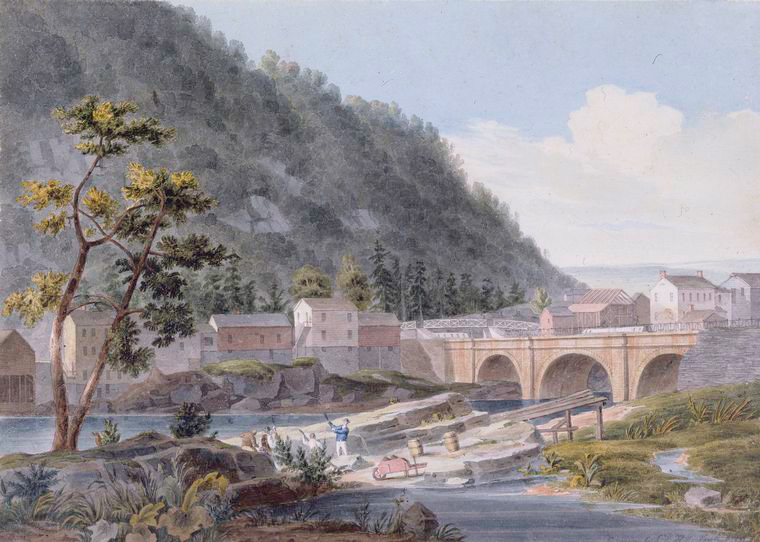
John William Hill, View on the Erie Canal, watercolor, 1831. Source: I.N. Phelps Stokes Collection, New York Public Library Digital Collections (no known restrictions).
Sourcing Questions
- This watercolor was created in 1831, just six years after the canal opened. How might the newness of the canal affect the artist's perspective?
Guided Observation
- What does the canal look like compared to the surrounding landscape?
- What buildings and businesses have grown up along the canal? What are the people in the foreground doing?
- This canal was dug by hand over 8 years. What kind of labor was involved?
Corroboration
How does this image support the textbook's claim that the Erie Canal transformed American commerce?
Citation
Hill, John William. View on the Erie Canal. Watercolor, 1831. I.N. Phelps Stokes Collection, New York Public Library.