Historical Thinking Skills
As you read each source, practice these four skills:
- Sourcing Who created this? When? Why?
- Contextualization What was happening when this was created?
- Close Reading What exactly does it say? What stands out?
- Corroboration How does it compare to other sources?
Margaret Bayard Smith on Jackson's Inaugural
Before You Read
When Andrew Jackson was inaugurated, thousands of ordinary citizens crashed the White House reception. The crowd was so large and rowdy that Jackson had to escape through a window. Margaret Bayard Smith, a Washington socialite, described the scene.
What a scene did we witness!… a rabble, a mob, of boys, negros, women, children, scrambling, fighting, romping. What a pity, what a pity!… Cut glass and china to the amount of several thousand dollars had been broken in the struggle to get the refreshments… Ladies fainted, men were seen with bloody noses.
Vocabulary
- rabble — a disorderly crowd
- romping — playing roughly
- inaugural — related to an inauguration, the ceremony of taking office
Sourcing Questions
- Margaret Bayard Smith was a wealthy Washington socialite. How does her social class affect her reaction?
- Is she horrified by democracy or by disorder?
Close Reading
- Who showed up to Jackson's inauguration who wouldn't have shown up before? Why is that significant?
- What specific details show how chaotic the event was?
Corroboration
The textbook describes Jacksonian democracy as expanding voting rights for white men. Does this account illustrate that change?
Citation
Smith, Margaret Bayard. "Letter Describing Andrew Jackson's Inauguration." 1829. In The First Forty Years of Washington Society. Scribner's, 1906.
The Indian Removal Act
Before You Read
This law gave President Jackson the power to negotiate 'removal treaties' with Indigenous nations living east of the Mississippi. In theory, removal was voluntary. In practice, it was forced at gunpoint.
It shall and may be lawful for the President of the United States to cause so much of any territory belonging to the United States, west of the river Mississippi… to be divided into a suitable number of districts, for the reception of such tribes or nations of Indians as may choose to exchange the lands where they now reside, and remove there… Provided, That such removal shall be voluntary, and with the free consent of the tribes.
Vocabulary
- lawful — allowed by law
- reception — receiving, welcoming
- reside — to live in a place
- consent — agreement, permission
Sourcing Questions
- Who wrote this law? Whose interests does it serve?
- The law says removal should be "voluntary." Why might lawmakers include that word?
Close Reading
- The law says removal should be with "the free consent" of the tribes. Does that match what actually happened?
- What does the gap between the law's words and its enforcement tell you?
Corroboration
Compare this law's language with the reality described in John Burnett's account of the Trail of Tears (Source 9.3).
Citation
"Indian Removal Act." 28 May 1830. United States Statutes at Large, vol. 4, p. 411.
The John Burnett Letter: A Famous Account That Is Almost Certainly Fake
Before You Read
For more than a century, this letter was treated as the best eyewitness account we had of the Trail of Tears. It is quoted in museums, documentaries, and textbooks. It is supposed to be the confession of an old soldier named John G. Burnett, written for his children on his eightieth birthday in 1890, about the removal he helped carry out in 1838.
Researchers have now shown it is almost certainly a fabrication. Army records show that Burnett’s company left service in April 1837 — more than a year before the removal he claims to describe. His unit took part in earlier operations in 1836 and 1837, not the 1838–39 march. And no U.S. soldiers travelled west with the Cherokee on that march at all, so no soldier could have seen what this letter describes. The researcher Larry Vogt, building on earlier work, traced the letter to Burnett’s grandson, writing decades later.
So why is it still here? Because a false source that everybody believed is one of the most useful things a young historian can study. Real events do not need invented witnesses, and the Cherokee left their own accounts of the removal. Your job with this document is not to feel what it wants you to feel. It is to work out how it fooled people for a hundred years.
The disputed text reads:
I saw the helpless Cherokees arrested and dragged from their homes, and driven at the bayonet point into the stockades. And in the chill of a drizzling rain on an October morning I saw them loaded like cattle or sheep into 645 wagons and started toward the west… One can never forget the sadness and solemnity of that morning.
Vocabulary
- stockades — enclosed areas used as prisons
- bayonet — a blade attached to the end of a rifle
- solemnity — a feeling of deep seriousness
Sourcing Questions
- Three facts sank this document: the company left service in April 1837, the removal happened in 1838–39, and no U.S. soldiers marched with the Cherokee. Explain in your own words why each one is a problem for the letter.
- The letter is dated 52 years after the events. On its own, a long gap does not make a source false — people write memoirs late in life all the time. What turned the gap from “worth checking” into “this cannot be true”?
- This document was believed by historians, museums, and textbook writers for over a hundred years. What made it so convincing? Be specific about the writing.
Close Reading
- Find two details that sound like eyewitness testimony — the kind only someone present would know. Now that you know the author was not present, where do you think those details came from?
- The letter says the Cherokee were “loaded like cattle or sheep.” That line is quoted everywhere. Does knowing the source is fabricated change what the line tells us about 1838 — or about 1890, when it was written?
Corroboration
This is the real work. Compare this letter with Source 9.1 and Source 9.2 on this page, and with the Indian Removal Act itself. Which claims in the Burnett letter are supported by documents we know are genuine, and which appear nowhere else?
Then answer the question that matters: the Trail of Tears really happened, and it really was that cruel. If a famous piece of evidence for it turns out to be fake, what should a historian do next — and why is “stop believing the whole event” the wrong answer?
Citation
Attributed to Burnett, John G. "The Cherokee Removal Through the Eyes of a Private Soldier." Dated 1890. Museum of the Cherokee Indian.
On the authenticity: Larry A. Vogt, Myth, Legend, Hoax, and History: The John G. Burnett Letter and Trail of Tears (2020), building on Lathel Duffield (2002) and William Higginbotham (1988), documents that the letter is a fabrication. Muster records place Burnett's company out of service in April 1837.
Cherokee Phoenix Newspaper Masthead
Before You Read
The Cherokee Phoenix was the first Native American newspaper, published in both English and Cherokee (using the Sequoyah syllabary). Its very existence challenges the idea that Indigenous peoples were 'uncivilized.'
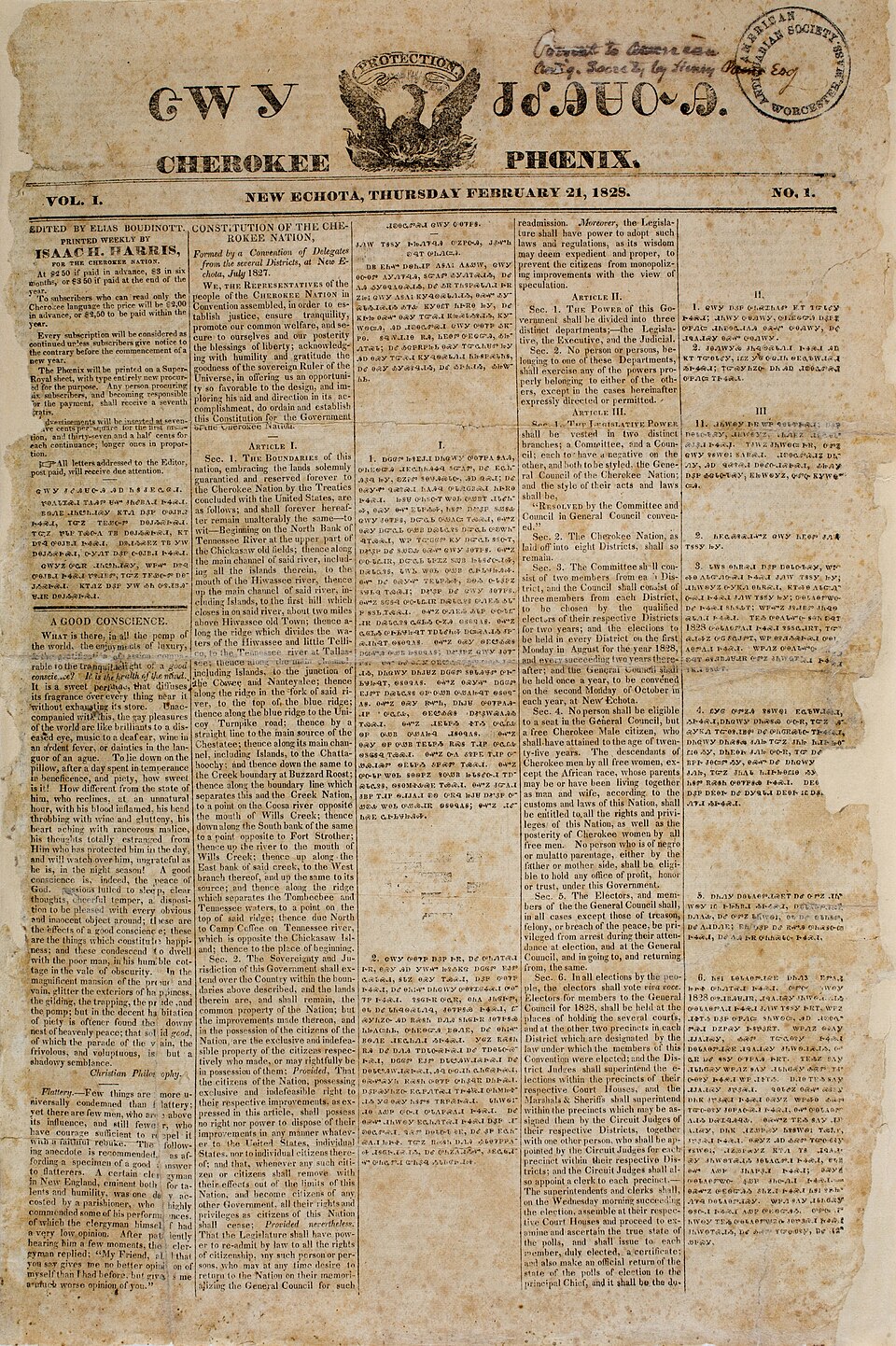
Cherokee Phoenix, Vol. 1, No. 1, February 21, 1828. The first newspaper published by Native Americans. Source: Library of Congress (public domain).
Sourcing Questions
- The Cherokee Phoenix was published by the Cherokee Nation. What was its purpose?
Guided Observation
- What languages appear on the masthead?
- What does a bilingual newspaper tell you about Cherokee society?
- How does this artifact challenge Andrew Jackson's argument that removal was necessary because Native peoples couldn't live alongside white Americans?
Corroboration
The textbook discusses the Cherokee as one of the "Five Civilized Tribes." How does this newspaper support or complicate that label?