Historical Thinking Skills
As you read each source, practice these four skills:
- Sourcing Who created this? When? Why?
- Contextualization What was happening when this was created?
- Close Reading What exactly does it say? What stands out?
- Corroboration How does it compare to other sources?
Solomon Northup, Twelve Years a Slave
Before You Read
Solomon Northup was a free Black man from New York kidnapped and sold into slavery in Louisiana in 1841. He spent twelve years enslaved before being rescued. His memoir describes daily life under slavery in devastating detail.
The hands are required to be in the cotton field as soon as it is light in the morning, and, with the exception of ten or fifteen minutes, which is given them at noon to swallow their allowance of cold bacon, they are not permitted to be a moment idle until it is too dark to see, and when the moon is full, they often times labor till the middle of the night. They do not dare to stop even at dinner time, nor return to the quarters, however late it be, until the order to halt is given by the driver… Each one must then attend to his respective chores. One feeds the mules, another the swine — another cuts the wood, and so forth… Finally, at a late hour, they reach the quarters, sleepy and overcome with the long day's toil.
Vocabulary
- overseer — a person who watched over and directed enslaved workers
- quota — a required minimum amount
- allowance — a rationed portion of food
Sourcing Questions
- Northup was a free man who experienced slavery. How does that perspective differ from someone born into slavery?
- He published this to expose slavery. Does that purpose affect his reliability?
Close Reading
- What specific details show the total control enslavers had over every moment?
- When do the enslaved workers get to rest?
Corroboration
How does Northup's account compare to the textbook's description of plantation life?
Harriet Jacobs, Incidents in the Life of a Slave Girl
Before You Read
Harriet Jacobs wrote one of the only slave narratives by a woman, describing the specific horrors enslaved women faced — including sexual abuse by enslavers. She published under the pseudonym 'Linda Brent.'
Slavery is terrible for men; but it is far more terrible for women. Superadded to the burden common to all, they have wrongs, and sufferings, and mortifications peculiarly their own… My master began to whisper foul words in my ear. Young as I was, I could not remain ignorant of their import.
Vocabulary
- superadded — added on top of
- mortifications — feelings of shame and humiliation
- peculiarly — uniquely, specifically
- import — meaning
Sourcing Questions
- Jacobs used a pseudonym. Why?
- She's describing sexual abuse carefully but clearly. Why might she write this way in 1861?
Close Reading
- What does Jacobs mean by wrongs "peculiarly their own"?
- Why does she say slavery is "far more terrible for women"?
Corroboration
How does Jacobs's account add to your understanding beyond what Northup describes?
Broadside for a Slave Auction at Ryan's Mart, Charleston (1852)
Before You Read
Broadsides like this were posted publicly across the South to advertise slave auctions. They are among the most chilling primary sources from this era — treating human beings as commodities to be bought and sold. This one announces the sale of 25 people at Ryan's Mart in Charleston, described as "accustomed to the culture of Sea Island Cotton and Rice." Read the list at the bottom carefully. These were real people.
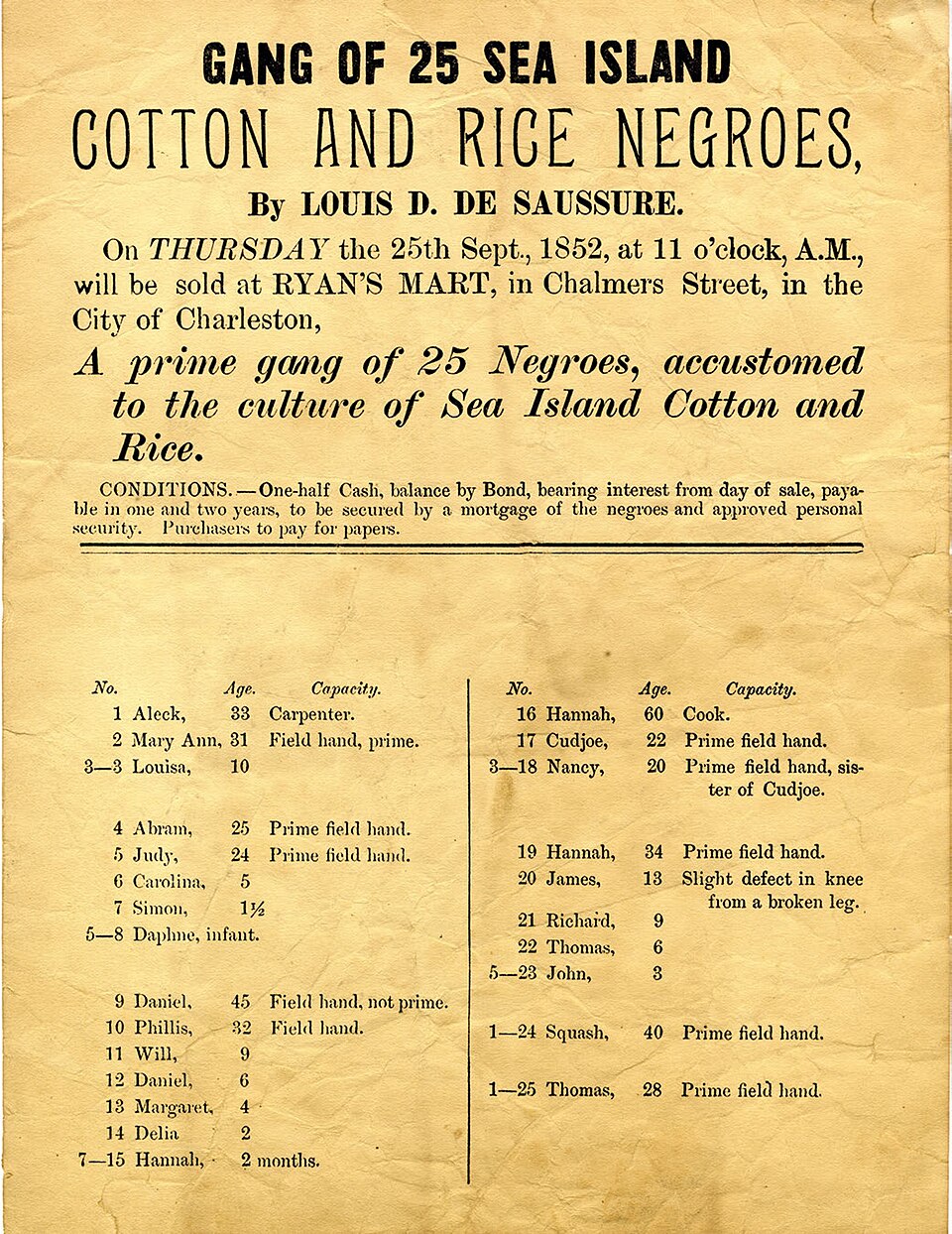
Broadside, "Gang of 25 Sea Island Cotton and Rice Negroes," Charleston, S.C., 1852. Source: Littlejohn Collection, Wofford College, via Wikimedia Commons (CC BY-SA 4.0).
Guided Observation
- What specific language is used to describe human beings?
- Look at the list of names and ages. What do you notice? Which entries stand out to you?
- How does this document make you feel? Why?
- What does this tell you about how slavery was embedded in everyday life and business?
Corroboration
How does seeing this broadside change your understanding compared to reading about slavery in a textbook? How does it connect to what Solomon Northup and Harriet Jacobs describe in the sources above?
Citation
"Gang of 25 Sea Island Cotton and Rice Negroes" [broadside]. Charleston, S.C., 1852. Littlejohn Collection, Wofford College.
"Go Down, Moses" — Spiritual
Before You Read
Enslaved people created spirituals — songs expressing suffering, faith, and hope for freedom. Many had double meanings: 'Go Down, Moses' sounds like a Bible story, but it was also a coded call for liberation.
When Israel was in Egypt's land / Let my people go / Oppressed so hard they could not stand / Let my people go / Go down, Moses / Way down in Egypt's land / Tell old Pharaoh / Let my people go.
Vocabulary
- Pharaoh — the ruler of ancient Egypt (in the song, a stand-in for enslavers)
- oppressed — kept down by unjust use of power
- spiritual — a religious song created by enslaved African Americans
Sourcing Questions
- Spirituals were created communally and passed down orally. How is this different from a written document?
- Why would enslaved people use Bible stories to talk about their own lives?
Close Reading
- Who is "Pharaoh" in this song? Who are "my people"?
- Why was double meaning necessary — what would happen if their true meaning was understood?
Corroboration
How does this song connect to the other forms of resistance described in the textbook?
Citation
"Go Down, Moses." Traditional spiritual. First published as "The Song of the Contrabands — 'O Let My People Go'" (1862); collected in Slave Songs of the United States (1867).