Historical Thinking Skills
As you read each source, practice these four skills:
- Sourcing Who created this? When? Why?
- Contextualization What was happening when this was created?
- Close Reading What exactly does it say? What stands out?
- Corroboration How does it compare to other sources?
John L. O'Sullivan, "Manifest Destiny"
Before You Read
John O'Sullivan, a newspaper editor, coined the phrase 'Manifest Destiny' to argue that it was America's God-given right to expand across the entire continent. This idea would be used to justify the Mexican-American War, the removal of Indigenous peoples, and the seizure of vast territories.
…the right of our manifest destiny to overspread and to possess the whole of the continent which Providence has given us for the development of the great experiment of liberty and federated self-government entrusted to us.
Vocabulary
- manifest — clear, obvious
- destiny — fate, what is meant to happen
- Providence — God's guidance
- federated — united under a central government
Sourcing Questions
- O'Sullivan is a newspaper editor trying to influence public opinion. How does that role shape his writing?
- Who benefits from this idea?
Close Reading
- Who is the "us" in this sentence?
- O'Sullivan says expansion is about "liberty." Whose liberty? Who loses liberty as America expands?
Corroboration
How does this idea connect to the Indian Removal you read about in Chapter 9?
Citation
O'Sullivan, John L. "Annexation." United States Magazine and Democratic Review, July–Aug. 1845.
A Mexican Perspective on the War
Before You Read
Almost everything Americans learn about the Mexican-American War comes from the American perspective. But Mexicans experienced this war as an invasion. José María Roa Bárcena, a Mexican writer, described the American attack on Mexico City and the young Mexican cadets (Los Niños Héroes) who fought to the death defending the military academy at Chapultepec.
The cadets of the Military College, mere boys, fought with a courage that would have honored veterans. They refused to surrender even as the walls crumbled around them. Six of these young cadets fell defending their post — the youngest was only thirteen years old. In Mexico, they are remembered as Los Niños Héroes — the Boy Heroes — symbols of courage against an invading army.
Vocabulary
- cadets — military students
- veterans — experienced soldiers
- invading — entering a country by force
Sourcing Questions
How is this account different from what an American writer might say about the same event? Why do we need both perspectives?
Close Reading
- Why does Roa Bárcena emphasize the youth of the cadets?
- What does calling them "heroes" tell you about Mexican memory of this war?
Corroboration
Americans call this the "Mexican-American War." Mexicans call it "The American Intervention." What does that difference in names tell you?
Citation
Roa Bárcena, José María. Recuerdos de la Invasión Norteamericana. 1883.
"American Progress" by John Gast
Before You Read
This painting shows 'Columbia,' a figure representing America, floating westward carrying telegraph wire and a schoolbook. Behind her: trains, settlers, cities. Ahead of her: Indigenous peoples and bison fleeing into darkness. This is one of the most famous — and most revealing — images of Manifest Destiny.
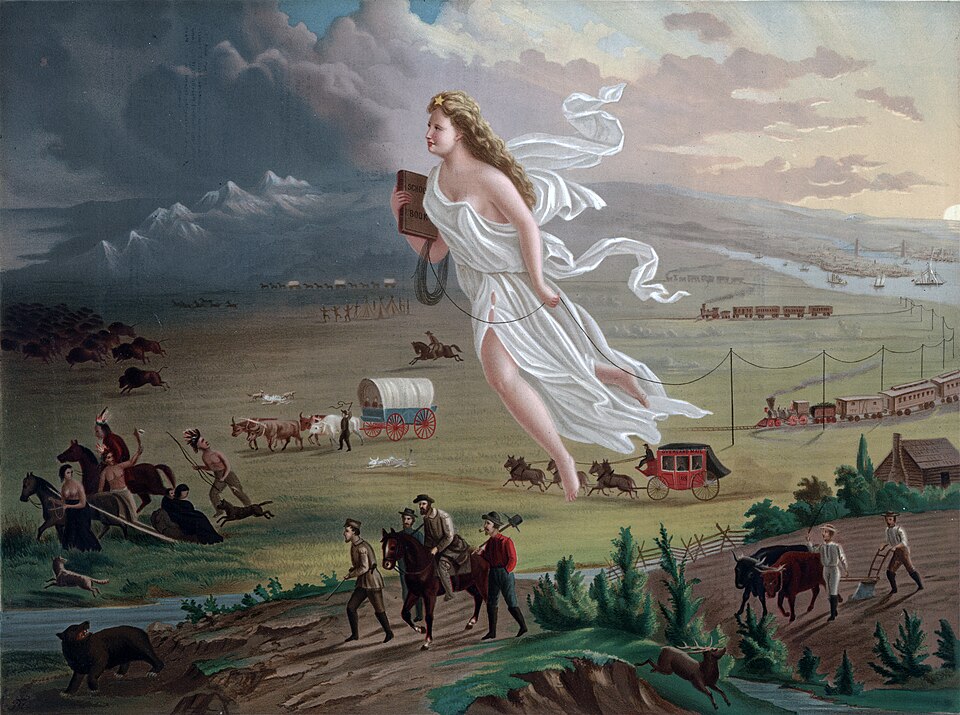
John Gast, "American Progress," 1872. Source: Library of Congress (public domain).
Guided Observation
- What is moving from right to left? What is fleeing left?
- What is the woman carrying? Why those specific objects?
- Notice the lighting — bright behind Columbia, dark ahead. What message does this send?
- Is this painting celebrating or criticizing westward expansion?
Corroboration
How does this painting illustrate O'Sullivan's idea of "Manifest Destiny"?
Oregon Trail Diary — Amelia Stewart Knight
Before You Read
Amelia Stewart Knight kept a diary during her family's journey from Iowa to Oregon in 1853. Her entries are short, practical, and reveal the daily reality of the overland trail.
Saturday, June 18: Had a dreadful storm of rain and hail last night and very windy. I never saw hail as large — Loss one of our oxen. He dropt dead in the yoke…
Monday, August 8: We have to cross a long chain of mountains today. Husband is sick. I have a fever…
Friday, September 9: A few days later my eighth child was born.
Vocabulary
- yoke — a wooden beam used to harness oxen
- dreadful — terrible
- chain of mountains — a mountain range
Sourcing Questions
- Knight is writing for herself, not for publication. How does that affect her honesty?
- What can a diary tell us that a history book can't?
Close Reading
- What are the biggest daily dangers on the trail?
- What does Knight's matter-of-fact tone tell you about the people who made this journey?
- She mentions giving birth in just one sentence. What does that reveal?
Corroboration
How does this diary compare to the glorified image of westward expansion in "American Progress"?
Citation
Knight, Amelia Stewart. "Diary of Amelia Stewart Knight." 1853. Oregon Historical Society.